Showing posts with label war. Show all posts

Tuesday, December 13, 2011

Attawapiskat, Katrina and imperialism


In September 2005, hundreds of thousands of people surrounded the White House under the banner "make levees, not war"--connecting the anti-war and climate justice movements in the wake of Hurricane Katrina. Of all the people I saw, one captured the moment best and let me take her photo: an African-American woman holding up a hand-made sign saying "No Iraqis left me on a roof to die"-- contemporizing Mohammed Ali's famous quote against the Vietnam War. While the US government demonizes Arabs and Muslims, and spends billions on war and occupation, the tragedy of Hurricane Katrina showed that the major threat was at home--in the form of poverty, racism, environmental destruction, and cut-backs.

ATTAWAPISKAT: CANADA'S KATRINA
     "This is the Native people's Katrina moment", said an Attawapiskat resident in reaction to the current crisis. Both juxtaposed oppression and opulence--from the black community of New Orlean's 9th Ward who were left to die on rooftops in the shadow of the wealthy French Quarter, to the indigenous community of Attawapiskat who were left to die in tents in the shadow of the richest diamond mine in the Western world. Both were symptomatic of a much broader problem stemming from slavery and colonialism. As NDP Member of Parliament Charlie Angus described, in a series of articles that helped highlight the crisis:

"Attawapiskat is the tip of the iceberg for the numerous Bantustan-style homelands of the far north. Years of chronic under funding and bureaucratic indifference has created a Haiti north where dying in slow motion on ice-filled shantytown is considered the norm."

     Both government responses seemed incompetent, but were ideologically-driven: first ignoring a tragedy that affected poor and racialized communities, then scapegoating them as criminals (for accessing food or allegedly mismanaging funds), then cramming them into a sports complex, and then trying to forcibly relocate them. Both emergencies became opportunities for disaster capitalism. As Robert Lovelace explained


"The tragedy at Attawapiskat was not only predictable it was planned. The current government has promoted an ideological solution to the "Indian problem" ever since the Conservative's incubation as the Reform Party. Their strategy needs a tipping point to convince the Canadian public that it is the only, and more importantly the final, solution. If it not Kashechewan or Attawapiskat, it will be some other community taken to the depth of despair. The plan is to dissolve Reserve communities through offering them up as private property to individual band members and turning Bands into municipalities. One more step away from the legal titles and rights protected under Section 35 of the Canadian Constitution and one more step toward complete economic and social chaos in Indian country."
OIL, PRISONS AND WARFARE
     To push its austerity agenda the Harper government claims to have no money and demands ordinary people pay for the economic crisis. The accusation that the people of Attawapiskat mismanaged funds is part of this broader narrative, with a specific racist focus on First Nations. The specific accusation of mismanaging $90 million was demolished by this article, and it's worth putting the $90 million into the broader context of government spending. 
     While the Harper government claims that $0.09 billion was generous for all the needs of Attawapiskat, it spends $1.4 billion on subsidizing the tar sands--which destroys indigenous lands. It plans on spending $10 billion on prison expansion--and will incarcerate a greater number of indigenous people if its draconian Bill C-10 is passed. And the Harper government plans on wasting billions on oil wars abroad--from $15 billion on fighters jets (the potential real cost of $30 billion is too big to fit on the graph), to $25 billion on naval warships. 
     Harper justifies the massive military spending on the claim that "the major threat is Islamicism", and that we need to continue the occupation of Afghanistan into its second decade. But to paraphrase--no Afghans left the people of Attawapiskat in tents to die.


SELF-DETERMINATION
     Another justification for militarism is that it can impose democracy, women's rights or development on communities who supposedly lack the ability to do so on their own. The inherent paternalism in this motive has accompanied Canadian military interventions from Afghanistan, to Haiti, to Libya, and builds on the colonialism on which Canada is based. Because the poverty and oppression that produce humanitarian crises are themselves products of colonialism and imperialism, sending more troops does not solve the problem and instead reinforces the denial of self-determination, whether in Haiti or Haiti north. So if the NDP does convince Harper to send the military to Attawaspiskat, it will become a photo-op to justify military spending and wars abroad, while doing nothing to decolonize at home. Instead we need to support the people of Attawapiskat to meet their own needs, as we collectively challenge the tar sands economy, the war and austerity of the Harper government, and colonialism. As Lovelace explained:

"The antidote for poverty is self-determination and no one can give you that. You have to stand up and take action yourself to make it happen. Colonialism does not give way on its own; it must be defeated through vigorous and enlightened opposition...Only through a convergence of our own self-determination and a willingness of Canada to decolonize can real change take place."

Thursday, July 28, 2011

Unethical oil

Today, "cog in the Conservative machine" Alykhan Velshi relaunched his website "ethical oil", with a series of ridiculous posters. Based on Ezra Levant's tar sands book by the same name, the posters take aim at "the world's bastards" (Iran, Venezuela, Saudi Arabia, and Sudan). As Velshi argues "When you’re filling up the tank, I think you’re indirectly funding them and their pet projects." The "ethical oil" argument counterposes "foreign oil" with Canada's tar sands--claiming that the latter promotes the environment, human rights, peace and democracy. Below are alternative posters to expose the myth of "ethical oil" and argue that a green economy free of the tar sands is the only viable future for the planet and its people.

ENVIRONMENT

Counterposing tar sands oil with other oil is a false dichotomy. The oil economy in general is leading the world to catastrophic climate change, and the tar sands is accelerating this process. According to Greenpeace,
"The tar sands cover an area of land the size of England, which has been divided up and leased to the world’s biggest oil companies...The tar sands use more water every day than a city of two million people and consume enough natural gas to heat six million Canadian homes. Until the oil boom, the tar sands were too expensive to be economically viable. But our global addiction to oil has us scraping the bottom of the barrel. The tar sands generate 40 million tonnes of CO2 per year, more than all the cars in Canada combined...As the fastest growing source of greenhouse gas emissions in the country, the tar sands are the main reason Canada continues to block meaningful global climate regulations. The Canadian government ignores the warnings of the scientific community by aiming for abysmal targets that will leave us at nearly double the science-based target that we need to meet to keep the increase in global temperature below 2 C and avoid catastrophic climate change."
INDIGENOUS RIGHTS

The claim that tar sands promotes indigenous rights has been exposed by indigenous people themselves, who are leading the fight against tar sands. According to the Indigenous Environmental Network,
"Indigenous peoples (known as First Nations) in Canada are taking the lead to stop the largest industrial project on Mother Earth: the Tar Sands Gigaproject...The cultural heritage, land, ecosystems and human health of First Nation communities including the Mikisew Cree First Nation, Athabasca Chipewyan First Nation, Fort McMurray First Nation, Fort McKay Cree Nation, Beaver Lake Cree First Nation Chipewyan Prairie First Nation, and the Metis, are being sacrificed for oil money in what has been termed a “slow industrial genocide”. Infrastructure projects linked to the tar sands expansion such as the Enbridge Northern Gateway pipeline and the Keystone XL pipeline, threaten First Nation communities in British Columbia, Canada and American Indian communities throughout the United States. Community resistance is growing and Indigenous peoples throughout North America have mounted substantive challenges to tar sands expansion."
PEACE

The actions of the Harper government make the false dichotomy of "conflict oil" vs "ethical oil" obvious. As opposition Harper wanted Canada to join the oil war in Iraq, and as Prime Minister has persecuted US Iraq War resisters (with Velshi an eager participant) for trying to be ethical soldiers refusing to fight for conflict oil. While promoting the tar sands, Harper has extended the oil war in Afghanistan three times, already once extended his oil war in Libya (where NATO intervention is designed to undermine the Arab spring that threatens to overthrow all the Western-backed "bastards"), and plans on wasting billions on oil-dependent fighter jets to participate in further conflicts over foreign oil.

WORKER'S RIGHTS

The claim that tar sands production supports worker's rights ignores the experience of workers themselves. Last year a tar sands workers was fired for blogging about the conditions at Fort McMurray:
"We have options for bagged lunches to take to work that includes stale vegetables that are sometimes unwashed (and occasionally are rotten/slimy), green fruit, sandwiches so high in salt it would terrify you, and a selection of donuts/cookies/cupcakes that would make Tim Horton's pale in comparison...All the vents are connected together so that if one person gets sick you are almost guaranteed to get it as well, the only answer is to stuff your vents with towels and live with stuffy stale air. It is not uncommon to have dozens of people ill, and there are occasional outbreaks of flu or cold that can affect hundreds at a time...There is no viable complaint procedure, no responsible person to notify of low quality or dangerous conditions, as camp patrons we are almost entirely helpless and at the whim of these people and they know it. This only reinforces the general resentment (or forced acceptance) of these conditions."
DEMOCRACY

The simplistic and racist dichotomy between inherent Western democracy and inherent Middle East dictatorship ignores Western arms sales to dictatorships, Western political support for dictators (from Paul Martin's support for Libyan dictator Muamaar Gaddafi, to Harper's support for Egyptian dictator Hosni Mubarak), and Western oil companies profiting from dictatorships (like Canada's Suncor operating in Libya and Syria, as well the tar sands). Meanwhile the Harper government has ignored majority support for a green economy, highlighted last year by Greenpeace's banner drop from Parliament. According to a poll last year,
"over 70 percent of Canadians support redirecting of military spending toward efforts that reduce greenhouse gas emissions, as well as the idea of a World Climate and Justice Tribunal to judge and penalize countries and corporations whose actions have contributed climate change. Over 80 percent of Canadians believe the Canadian government should invest in “green jobs” and transition programmes for workers and communities negatively affected by a shift off of fossil fuels."
Despite attempts to greenwash the tar sands, the majority of people support a truly green economy--and movements uniting indigenous groups, environmentalists, the labour movement and the anti-war movement are working to bring for this democratic and green future to life. 

Saturday, July 23, 2011

The bombs in Afghanistan have landed in Norway

A decade of Islamophobia to justify the war in Afghanistan is now spreading violence to the West. Right-wing Islamophobe Anders Behring Breivik has killed 91 people in Norway, through the explosion of a bomb near the Prime Minister's building and a shooting spree in a youth camp organized by the Workers’ Youth League.
     The initial response by international media was to blame Muslims. But when the alleged perpetrator turned out to be a blond-hair, blue-eyed Norwegian Christian nationalist, some are now denying there’s any context whatsoever for the killing. As a Norwegian official said, "It seems it's not Islamic-terror related. This seems like a madman's work." 
     But Breiviks was not driven by "madness", he was driven by right-wing Islamophobic politics. From 1997 to 2007 he was a member of the xenophobic "Progress Party". Since that time police chief Sveinung Sponheim describe his internet postings as having “some political traits directed toward the right, and anti-Muslim views”, and others have pointed out his an admirer of prominent anti-Muslim individuals and organizations like Geert Wilders and the English Defense League.

ISLAMOPHOBIA
     Islamophobia existed well before the terror attacks of 9/11. After the Oklahoma City bombing of 1995 (orchestrated by Gulf War veteran and right-wing extremist Timothy McVeigh), the media blamed Muslims, and the American-Arab Anti-Discrimination Committee documented death threats against Muslims and vandalism of mosques. But for the past decade there has been a surge in Islamophobia to scapegoat populations at home and justify wars abroad.
     The Western countries with Islamophobic policies overlaps with those occupying Afghanistan: from the US (which incarcerated Muslims without trial in Guantanamo Bay), to Canada (which has rounded up Muslim men and pressured them to admit to terrorism, while Muslim Canadians have been abandoned abroad, and media have amplified fringe-group campaigns against prayer spaces), to France (which is banning girls who wear hijab from school, and women who wear niqab from public space), to Norway.
     The website Islamophobia-watch has documented anti-Muslim racism around the world, which in Norway includes:

-2006: the Directorate for Primary and Secondary Education of Norway banned girls and women wearing niqab form school
 -2007: anti-immigration politicians in Bergen threatened to use pigs feet to chase praying Muslims out of a public square.
-2009: the Norwegian government tried to ban female police officers from wearing the hijab
-April 2011: attempts were made to set up a Norwegian Defense League—modeled on the English Defense League--with a demonstration was called against the “Islamic occupation of Noway”. While only 10-15 Islamophobes turned up, up to 1000 people attended a counter-demonstration
-May 2011: a school in Bergen had to be evacuated when a national newspaper received a message threatening “A massacre at Gimle school Bergen. Everyone that stands in the way will die, especially Muslims”

     But police have refused to see Islamophobia as a threat. “It’s surprising, because the Norwegian police have long said that the right wing extremist community was under control,” said Hegghammer, of the Norwegian Defense Research Establishment.
FIGHT POVERTY, RACISM AND MILITARISM
     As Martin Luther King famously said:
demo against the Norwegian Defense League, April 2011

“The bombs in Vietnam explode at home. They destroy the hopes and possibilities for a decent America. If we reversed investments and gave the armed forces the anti-poverty budget, the generals could be forgiven if they walked off the battlefield in disgust. Poverty, urban problems and social progress generally are ignored when the guns of war become a national obsession.”

     The horrific crimes of Anders Behring Breivik have exposed the consequences of war and Islamophobia, which are intensifying in the economic crisis. To counter this we must follow the words of King: 

"Our only hope today lies in our ability to recapture the revolutionary spirit and go into a sometimes hostile world declaring eternal hostility to poverty, racism, and militarism."


Friday, June 3, 2011

Mladic, war criminals and "humanitarian intervention"


Serbian war criminal Ratko Mladic is sitting in the Hague for his role in the siege on Sarejevo and the massacre at Srebrenica during the Bosnia war of the early 1990s. He certainly belongs in the Hague but so do Western war criminals like Henry Kissinger and George Bush. As NATO extends its 3 month war in Libya and  there are growing calls for Libyan dictator Muamar Gaddafi to join Mladic, the history of NATO wars in the Balkans offers lessons on "humanitarian intervention".
 
WESTERN WAR CRIMINALS
While justice has finally come for Mladic, it is still long awaited for other war criminals. Earlier this week an American tried to carry out a citizens arrest of Henry Kissinger for his role in an almost endless list of war crimes. As Richard Marini explained:

“When he got up on stage, I stood up and tried to place him under citizen’s arrest for the murder of innocent civilians in Cambodia, Vietnam, Chile, Iraq, east Pakistan, East Timor. The list just goes on...People like this need to be confronted, so people need to get out in the streets and demand that war criminals like him and war criminals of the Bush administration are prosecuted. I mean, even today, these war crimes still continue. Obama is still continuing it. People need to demand that these criminals are prosecuted.”

     The illegal Iraq War has killed a million people, including torture at Abu Ghraib and the siege on Fallujah, the Sarejevo of Iraq. The Afghanistan war has killed countless civilians--including by US kill teams--and drone attacks have spread to Pakistan. The illegal occupation of Palestine continues, and as the media are focused on Mladic the US-backed regimes in Yemen and Bahrain are massacring demonstrators. While there are growing calls for Libyan dictator Muammar Gaddafi to join Mladic in the Hague, NATO is burying its role in arming him from 2004 to 2010. Canada’s Prime Minister Stephen Harper wanted to join the illegal Iraq War and is criminalizing war resisters, supported Israeli war crimes in Lebanon as a "measured response", and prorogued Parliament to distract from the Afghan detainee scandal.

"HUMANITARIAN INTERVENTION"
     The narrow focus on Mladic not only ignores other and ongoing war crimes, but obscures the lessons from Western “humanitarian intervention” in the Balkans. The fall of the USSR gave US imperialism access to Caspian oil, and it used civil war in the Balkans as an excuse. As Ivo Daalder, an adviser to former US President Bill Clinton explained, “So long as the war festered, it proved impossible to exploit the opportunities created by the dissolution of the Soviet empire in Eastern Europe.” NATO imposed “no-fly zones” supposedly to protect the Bosnian Muslim population. These morphed into an open air war that failed to stop Mladic from committing his crimes, gave the green light to Croatia to cleanse its Serbian population, and ended with an ethnically-cleansed Bosnia under NATO control.
     This was repeated in Kosovo in the late 1990s, another “humanitarian intervention” based on geopolitical interests. As US energy secretary Bill Richardson explained at the time,

"This is about America's energy security. It's also about preventing strategic inroads by those who don't share our values. We're trying to move these newly independent countries toward the West. We would like to see them reliant on western commercial and political interests rather than going another way. We've made a substantial political investment in the Caspian, and it's very important to us that both the pipeline map and the politics come out right."

The war claimed to be protecting Kosovar Albanians and is credited with getting rid of Milosevic, but NATO bombs precipitated further atrocities by both Serb forces and KLA, killed many more and contributed to a refugee crisis. Despite NATO bombs, the people of Serbia liberated themselves through a revolution in 2000, the first step to bringing Mladic to justice. 

LESSONS FOR TODAY
     Like Bosnia, NATO is using conflict in Libya to reassert control of an oil-rich region, this time one that is being rocked by popular revolutions. Like Bosnia, “no-fly zones” have morphed into an air war spreading depleted uranium without protecting people from Gaddafi. Like Serbians, the people of Libya and the broader Arab world have the ability to liberate themselves, and the best way we can help is by ending war and occupation in Palestine, Iraq, Afghanistan and Libya; stopping military sales and political support for Yemen, Bahrain, and other repressive regimes; welcoming war resisters, and one day sending our own war criminals to share a cell with Mladic and Gaddafi, beginning with Kissinger who's been invited to speak this month in Toronto. As Gerald Caplan writes,
"Unless some will attend in order to issue a citizen’s arrest against Dr. Kissinger – it’s been attempted in London and Dublin, and international arrest warrants were issued by judges in Spain and France – that means 2,630 Torontonians are prepared to pay good money to listen to a man responsible for untold human misery. This number is somewhat smaller than the 3,200 people murdered by the Pinochet regime in Chile that Henry Kissinger did so much to install and support."

Monday, April 25, 2011

Malaria, "tropical medicine" and imperialism

Today is the 4th annual World Malaria Day, when we recommit ourselves to ending the mosquito-spread disease that infects half a billion people and kills a child every 45 second. But in order to achieve the goal of no malaria deaths by 2015, need to consider why parts of the world are still devastated by it. If we've know the basics of malaria transmission for a century but it remains a threat, then we must be ignoring factors critical to its survival. What follows is a brief history of "tropical medicine" and the changing context that shaped its theory and practice.

TROPICAL DISEASE or POVERTY DISEASE
     The prevailing medical orthodoxy reduces infectious disease to an abstract interaction between an individual and a micro-organism, without considering the socioeconomic conditions that constrain the individual or facilitate the infection. As a result treatment is reduced to medicine and lifestyle choices, without considering an individuals ability to access medicine or to make certain lifestyle choices. As a result of this reductionst approach, medicine regards malaria and other infections that plague the Global South as 'tropical diseases'. But in 1954 the director of the Calcutta school of tropical medicine offered a critical response published in the British Medical Journal:
"There are not many diseases peculiar only to tropical climates, although admittedly conditions in the Tropics are more favourable to their growth and spread.. Such devastating diseases as cholera, smallpox, plague, malaria, and leprosy that now prevail here were once very common in Western countries. If taken in the sense of latitudes, labels such as 'tropical disease' and 'tropical medicine' are largely misnomers; what is worse, they perpetuate a false idea that tropical countries, try as they may, are doomed always to suffer from these diseases. 'Tropical' diseases disappeared from the West mainly for three reasons: first, better and abundant food as a result of better cultivation at home and the importation of food from overseas; secondly, the removal of poverty as a result of the industrial revolution and the acquisition of colonies; and, thirdly, the institution of public-health measures, which led to better housing and hygiene, improved sewerage, and a safe water supply. If we consider 'tropical disease' in this light much of it is reduced almost to 'poverty disease'."
COLONIAL MEDICINE
     But colonialism imposed the exact opposite conditions on the Global South, fanning the flames of infectious disease. "Tropical medicine" emerged in the context of the scramble for colonies--when direct colonial control was an economic necessity--in an attempt to overcome this contradiction: how to bring the infectious diseases under control without altering the colonial conditions that spread them. As the British Medical Journal stated in 1897, "get rid of or avoid these germs and we get rid of a principle obstacle to the colonization of the tropics by Europeans."
     Two years later Britain established two schools of tropical medicine as joint ventures between the state and major companies. The owner of a Liverpool shipping line whose company shipped home loot form Africa became one of the main founders of the Liverpool school, and stated that "money spent in our school of tropical medicine is an investment, and we expect dividends from it." For US colonialism, a major source of funding for tropical medicine came from the United Fruit Company, whose profitable Latin American plantations required cheap and efficient labour. A century ago, when direct colonial control was an economic necessity for empires, companies and states joined forces to pillage the tropics, and the development of tropical medicine accompanied these projects.
     A simple glance at the pioneers in the field should raise suspicion as to the driving force of tropical medicine: malaria advances were made by Alfonse Laveran (a French army doctor in Algeria) and Ronald Ross (a British army doctor in India), advances in yellow fever were made by Jesse Lazear and Walter Reed (American army doctors in Cuba) and William Gorgas (an American army doctor in Panama). Despite their contributions to science, the implementation of tropical medicine was subordinate to colonial priorities. In Sierra Leone, the British used the the discovery of the malaria mosquito vector as rationale for imposing residential segregation, so the colonial officers could sleep at a safe distance from the infected local population.
     In Egypt, Britain discovered that the local poor population had high rates of schistosomiasis. Concern for the economic impact of a possible spread throughout the Empire precipitated a frenzy of medical research to discover how it was spread. But when the disease was found to be spread by sails in pollutd water, and therefore completely avoidable by the British military, research abruptly stopped. The disease and its victims were forgotten. As the leading investigator concluded, schistosomiasis "should not be treated as one of those diseases for which the individual is mainly, if not entirely, personally responsible."
     Whereas efficienty of foreign troops was the main goal of the British military base of Egypt, int he Belgian colonization of the Congo the focus was on labour efficiency. The Congo already had a low rate of trypanosomiasis. But the brutal conditions of colonization turned the disease into a raging epidemic at the start of the 20th century. In response, Belgium threw resources into finding a drug to keep the exploitted work force alive without dampening the proftable conditions of their exploitation.
     In the US conquest of the Philippines, sanitation measures were an excuse for repression. In 1902, after three years of crushing the local resistance, a cholera epidemic swept through the country, killing 200,000. The US launched a "cholera war", a supposed sanitation scheme that was suspiciously similar to the initial war and occupation: quarantines, house burnings, detention camps, and agricultural destruction. Of course this only fanned the flames of the disease.

MODERN IMPERIALISM and the DECLINE OF TROPICAL MEDICINE
     The "tropical diseases" that remain are proof that Western intervention has not led to development. Not only has global economic development not shifted to the global south, it has become more concentrated in advanced industrialized countries. As the British economist Chris Harman explained
"It is worth remembering why the European powers retreated from their colonies in the 1950s and 1960s after a century and more of carving up the rest of the world between them. They found it increasingly difficult and costly to hold on to them once modern national liberation movements came into existence and every grievance of any class translated itself into hatred of foreign occupation. At the same time, the economics of capitalism began shifting against the direct holding of colonies. The most important growth areas for markets and profitable investment were increasingly within the advanced countries themselves. Africa, the centre of inter-imperialist conflicts over the division of territory a century ago, today only accounts for around 0.6 percent of total direct foreign investment, and Latin America only around 6 percent."
World pharmaceutical market
     The pharmaceutical companies have mirrored this shift, with the entire continent of Africa now constituting only 1.3% of the global drug market. It is not surprising, following the logic of capitalism, that only 1% of new drugs in the past generation have been developed for "tropical diseases". Trypanosomiasis still kills 40,000 a year, a while life-saving treatment was an obsession for Belgian capitalism a hundred years ago, all production was stopped in 1999 because it was not profitable to save lives (it resumed production when it was discovered it could also be used in facial cream). As the former head of Merck stated, in sharp contrast to the Liverpool capitalist a century ago, "a corporation with stockholders can't start up a laboratory that will focus on Third World disease, because it will go broke. That's a social problem and industry shouldn't be expected to solve it."
     HIV/AIDS is the one 'tropical disease' that also affects people in the global north, though like all disease it spreads along lines of poverty and inequality and most people living with the infection are in the Global South. So while governments and pharmaceutical companies were pressured by AIDS activists to develop effective treatment, they have kept these technologies out of the hands of most people who need them.
     The shift in the global market away from the global south has been mirrored by a corresponding shift in dominant health care views. Once 'tropical disease' was reduced to a biological phenomenon, the solution for which was a 'magic bullet' that could cure the disease without disturbing the profitable conditions of colonialism. Now the dominant theory has become public health nihilism: dismissing medicine and preaching behavioural  and lifestyle changes--mosquito nets for malaria, circumcision for HIV--and economic development under tutelage from the West. Acknowledging that the majority of people in the global south cannot afford overpriced brand-name drugs, but wanting to gouge patients in the North, the dominant view now creates a false dichotomy of treatment for the rich and prevention for the poor. But as Paul Farmer, one the world's leading experts on HIV/AIDS, who has pioneered treatment in Haiti, explained in his book Infections and Inequalities:
"Too often, those who elevate the role of social determinants indict clinical technologies as failed strategies. But devaluing clinical intervention diverts attention from the essential goal that it be provided equitably to all those in need. Belittling the role of clinical care tends to unburden policy of the requirement to provide equitable access to such care."
CORPORATE GLOBALIZATION
     But "economic development" along neoliberal lines--with privatization, user fees and budget cuts--has undermined access to care, increased poverty, and exacerbated infections. An article in The Lancet described the impact of neoliberal policies for malaria in Nicaragua:
"I find it ironic that the Contra War was less a barrier to effective malaria control than the Structural Adjustment Program of the 1990s. Neglect for the rural poor has resulted in an epidemic greater than any since malaria eradication began in Nucaragua in 1947. User fees in this area generate few financial resources but sabotage the malaria control program and send the mistaken message that malaria control elective, rather than an essential service and national commitment."
     Meanwhile, structural adjustment in South Africa led to a cholera epidemic. As the World Bank explained, "work is still needed with political leaders to move away from the concept of free water for all." The result of forcibly depriving people of clean water was to drive them to polluted lakes and streams, leading to a cholera epidemic that killed 300 and infected 250,000. While pharmaceutical giants tried to prevent access to generic HIV/AIDS medication in 2001, they were defeated by a global movement led by South Africa's Treatment Action Campaign.

WAR and OCCUPATION
     Whereas most investment is within advanced industrialized countries, there is one commodity that continues to drive war and occupation outside the centres of the global market: oil. The Western-backed occupation of Palestine, in addition to direct attacks on the population, has also spread infections. According to a 2004 report of the International Journal of Health Services,
"The increasing rate of infectious disease in the occupied territories is influences by such factors as lack of sanitary water, overcrowded living conditions, poverty, improper sewage disposal, incomplete immunization, and malnutrition--all conditions that have been exacerbated during the current Intifada and are directly linked to Israel's policies"
     Meanwhile the West is presenting war as a new form of topical medicine,with aerial bombardment cloaked in the language of public health: crackers were dropped along with cluster bombs on Afghaninstan, Iraq was attacked with "surgical strikes", and depleted uranium is bringing "humanitarian intervention" to Libya. The supposed concern for international health obscures the fact that the cost of one B-2 bomber covers the total future spending on malaria research for the next 20 years, during which time the disease will kill 40 million people in Africa.
     But whereas tropical medicine a century ago attempted to contain infectious disease in order to promote the efficiency of foreign troops or local labour, war today spreads infectious disease in the conquest of oil and expansion of markets. A Pentagon report written before the Gulf War theorized that if water sanitation were destroyed in Iraq, "unless the water is purified with chlorine, epidemics of such diseases as cholera, heptatitis and typhoid could occur." This outlined in advance the Gulf War and UN sanctions regime, which deliberately destroyed civilian infrastructure and maintained a situation of malnutrition and disease that killed 1.5 million people.

ECONOMIC CRISIS, HEALTH CARE CRISIS
     While governments have thrown hundreds of billions of dollars at corporate bailouts and military expansion, they have underfunded the Global Fund for AIDS, TB and Malaria. While AIDS medicine can reduce transmission turn the infection into a chronic illness, it is denied to millions resulting in a reversal of life expectancy in some countries. Tuberculosis infections a third of humanity and remains a leading infectious cause of death 50 years after the discovery of curative therapy. Meanwhile malaria continues to kill while treatment is growing old: the leading anti-malarial medication was developed by the US military during the Vietnam War. These three infections highlight the devastating contradictions of 21st century capitalism: each year they kill 6 million human beings, not because we don't have the material capacity or advanced technology to overcome them, but because both are subordinated to profit.
     To roll back Malaria, we need to roll back the socioeconomic factors that contribute to it, and urgently divert resources from military and corporate bailouts to global health and poverty--combining access to medicine with improved living standards for all. As the Treatment Action Campaign said in 2004,
"The effect of the US government's unlawful war in Iraq has been to divert international attenption and resources away from global health and poverty. Hundreds of billions of dollars are being spent on the military instead of investing resources in the biggest threats to human security today: HIV/AIDS, tuberculosis, malaria, malnutrition and poverty."

Sunday, April 17, 2011

Poem for Libya: Liberation through self-determination


The war on Libya’s a humanitarian disaster,
Depleted uranium fired by imperial masters.
Supposed salvation for the people of Benghazi,
While they murder Afghan, Palestinian and Iraqi.

How can it be, they ignore demands for medical supplies;
While Libyans die, the only help is bombing from the skies.
You can’t deny, we need asylum for refugees;
Instead they let them capsize and die in open seas.

Hypocriseas, it doesn’t take Hippocrates to see
The cure for Gaddafi is not those who sold arms to Tripoli.
Sarkosy bombs Libya while banning clothes for Muslim women;
Scapegoating them with islamophobic venom.

Don’t let him. And Obama’s bombs, a vehicle for AFRICOM:
Continuing 100 years of imperialism in Libya, it’s wrong.
Those who killed Omar Mukhtar don’t belong, have nothing to offer
But saving the profits of BP and SNC-Lavalin coffers.

Stephen Harper, joined the liberation of Libyan oil,
Using “Humanitarian intervention” to divide the spoils.
Makes my blood boil, the counter-revolution,
Those who armed Gaddafi—the source of persecution—are no solution.

Revolution of the Jasmine flower is what makes tyrants cower,
It wasn’t NATO that toppled Ben Ali and Mubarak, but labour power.
Now’s the hour, to continue liberation,
Bahrain, Yemen, Syria, which is the next nation?

Or perhaps Iraq, after 8 years of occupation,
Inspired by Tahrir is demanding liberation.
That’s the only salvation from this conflagration.
Real liberation comes through self-determination.

Monday, April 4, 2011

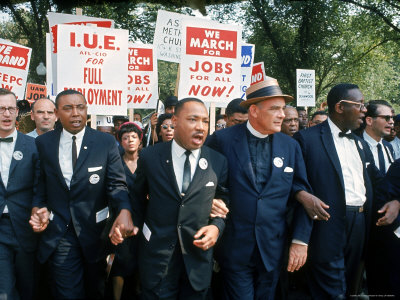
Continue King's dream: support workers rights, stop the war

The April 4 demonstrations for economic justice and April 9 demonstrations against war offer the chance to continue Martin Luther King's legacy. As he declared on April 4, 1967, "Our only hope today lies in our ability to recapture the revolutionary spirit and go into a sometimes hostile world declaring eternal hostility to poverty, racism, and militarism."


KING'S DREAM
     Martin Luther King, killed 43 years ago today, is often reduced to a saintly figure, a simple dreamer who advocated civil rights divorced from all other causes. But King was part of a mass movement that combined ideas with action, organizing multiracial non-violent civil disobedience that overthrew Jim Crow in the South. Through the process he not only got arrested dozens of times, but began connecting civil rights with other issues. Even by the time of his famous "I have a dream" speech, civil rights leaders were looking beyond the legal rights that were being won and connecting the fight against racism with the fight for economic justice. As Bayard Rustin, one of King's mentors and the chief organizer of the historic 1963 March on Washington for Jobs and Freedom, described:
“integration in the fields of education, housing, transportation and public accommodation will be of limited extent and duration as long as fundamental economic inequality along racial lines persists. When a racial disparity in unemployment has been firmly established in the course of a century, the change-over to ‘equal opportunities’ does not wipe out the cumulative handicaps of the negro worker. The dynamic that has motivated negroes to withstand with courage and dignity the intimidation and violence they have endured in their own struggle against racism may now be the catalyst which mobilizes all workers behind demands for a broad and fundamental program of economic justice”. 
Or as King put it, "What good is having the right to sit at a lunch counter if you can't afford to buy a hamburger." He also went further. Against the advice of Rustin and other civil rights leaders, King began speaking out against the Vietnam War, connecting the war abroad to the war at home. As he said in his speech on April 4, 1967,
"We were taking the black young men who had been crippled by our society and sending them eight thousand miles away to guarantee liberties in Southeast Asia which they had not found in southwest Georgia and East Harlem. And so we have been repeatedly faced with the cruel irony of watching Negro and white boys on TV screens as they kill and die together for a nation that has been unable to seat them together in the same schools. And so we watch them in brutal solidarity burning the huts of a poor village, but we realize that they would hardly live on the same block in Chicago. I could not be silent in the face of such cruel manipulation of the poor."
     King also spoke out against the impact of the war on the people of Vietnam, in words that could be written for the people of Afghanistan today:
"We increased our troop commitments in support of governments which were singularly corrupt, inept, and without popular support. All the while the people read our leaflets and received the regular promises of peace and democracy and land reform. Now they languish under our bombs and consider us, not their fellow Vietnamese, the real enemy."
 The following year, as he planned his Poor People's Campaign to return to Washington demanding economic justice, King went to support 13000 Memphis sanitation workers on strike. It was here, on April 4, 1968, that he was assassinated. The following week the Memphis workers won union recognition and wage increases.

KEEP KING'S LEGACY ALIVE: APRIL 4, APRIL 9
     Today hostility to poverty, racism and militarism is heating up again. Revolutions in Tunisia and Egypt detonated revolts across the Middle East and North Africa, and helped inspire Wisconsin workers to stand up against union-busting. Now their struggle has inspired the nation: On April 4, 2011 there are more than 1,000 demonstrations across the US for economic justice, which Martin Luther King III says his father would support. As the organizers of "We Are One" write, 
"Join in solidarity with working people in Wisconsin, Ohio, Indiana and dozens of other states where well-funded, right-wing corporate politicians are trying to take away the rights Dr. King gave his life for: the freedom to bargain, to vote, to afford a college education and justice for all workers, immigrant and native-born. It’s a day to show movement. Teach-ins. Vigils. Faith events. A day to be creative, but clear: We are one."
     This weekend will be another chance to keep Martin Luther King's legacy alive: on April 9 there will be rallies across the US and Canada against war. While there are attacks on public sector workers and budget cuts for healthcare and education, billions are being wasted on the bloody war in Afghanistan, the Vietnam War of our time which has recently reached its My Lai moment. As Seymour Hersh wrote,
"In photographs released by the German weekly Der Spiegel, an American soldier is looking directly at the camera with a wide grin. His hand is on the body of an Afghan whom he and his fellow soldiers appear to have just killed, allegedly for sport...We saw photographs, too, at My Lai 4, where a few dozen American soldiers slaughtered at least five hundred South Vietnamese mothers, children, and old men and women in a long morning of unforgettable carnage more than four decades ago."
     Despite support for the war by US Democrats and Republicans, and Canadian Liberals and Conservatives, a growing majority of Americans and Canadians (including growing numbers of troops and military families) are against the war and want the troops home. As Obama starts his re-election campaign, and Canadian parties enter the midway point of their election campaign--with the NDP being the only party to call for an end to the war--April 9 is an important chance to display the majority opposition to the war and make it an election issue.

DREAMERS AWAKE
     Martin Luther King was part of a revolutionary wave that swept the globe: the year 1968 saw student protests and urban revolts from France to the US, uprisings from Czechoslovakia to Pakistan, and the Tet offensive that galvanized the national liberation movement in Vietnam--to name but a few. This year we've already seen mass demonstrations against austerity from London to Wisconsin, revolution in Tunisia and Egypt, and ongoing revolt across the Middle East and North Africa. By learning from King we can continue his legacy:
"These are revolutionary times. All over the globe men are revolting against old systems of exploitation and oppression, and out of the wounds of a frail world, new systems of justice and equality are being born. The shirtless and barefoot people of the land are rising up as never before. 'The people who sat in darkness have seen a great light.' We in the West must support these revolutions."

Monday, March 28, 2011

Harp-natieff: corporate Canada's coalition

In the upcoming federal election, Canadians face the threat of a coalition: the unofficial alliance between the Liberals and the Conservatives that for years has promoted inequality and social program cuts, civil liberty violations, environmental destruction, weapons and war. Campaigning on these issues can help expose the real coalition threat, and promote alternatives at the ballot box and in the streets.


TWIN PARTIES OF CORPORATE CANADA
     Conservative Prime Minister Stephen Harper and Liberal leader Michael Ignatieff are increasingly merging. Ignatieff has even allowed Harper to defeat his own party's initiatives, from Bob Rae's maternal health motion in the lead up to the G20 protest, to John McKay's Bill C-300 that would hold mining companies accountable for human rights and environmental abuses. In fact, Ignatieff is so similar to Harper that he doesn't feel the need to even show up to Parliament: Ignatieff has the worst attendance record of any Member of Parliament, having missed 182 votes between 2008 and 2010.
     But the Liberal-Tory coalition is not based on the personalities of its leaders, but the composition of its base. While the NDP is based in the trade unions and social movements, the Liberals and the Conservatives represent the twin parties of corporate Canada (like the twin parties of corporate America, the Democrats and Republicans). They depend on, and enact policies to benefit Canadian corporations and elites (for more on this check out this article by Stephen James Kerr). It's for this reason that the Liberals and Conservatives have formed such a stable coalition for so many years, to the detriment of Canadians.


INEQUALITY and SOCIAL PROGRAM CUTS
     By opposing Harper's corporate tax cuts, the Liberals are trying to appeal to the majority of Canadians while hiding their own history. The Liberals under Paul Martin gave a $100 billion tax cut, while Ignatieff states on the Liberals' own website that "Liberal governments brought the corporate tax rate down from 28% to 19%". The accompanying graph shows a decade of corporate tax cuts by both Liberals and Conservatives, the Liberals only temporarily objecting to further cuts. Who paid for all this? According to the Canadian Centre for Policy Alternatives,
"The Liberal government balanced the books in the late 1990s thanks to swift and savage cuts to social programs. Program cuts allowed the government to balance its books, but also left a trail of growing poverty, widening income disparities, and deteriorating public services."  
After 12 years in power, the Liberals left Canada's child poverty rate the same as they found it, despite a boom in the economy. According to Statscan, "Between 1999 and 2005, the median net worth of families in the top fifth of the wealth distribution increased by 19%, while the net worth of their counterparts in the bottom fifth remained virtually unchanged." The Liberal-Tory coalition have continued their policies of serving the rich over the rest, giving, wiping out the $57 billion Employment Insurance surplus, and then defeating a bill to strengthen Employment Insurance.

CIVIL LIBERTY VIOLATIONS
     Harper is rightly being criticized for spending $1 billion on the G20 summit, including the largest mass arrest in Canadian history. This follows a trend set by the Liberals, from the 1997 APEC summit where Jean Chretien joked about pepper-spraying demonstrators in the face, to the 2001 mass arrests at the FTAA summit, to Bill C-35 and C-36 that criminalized protesters, to the half-billion dollar militarized G8 summit in Kananaskis. As members of the "opposition", the Liberals have joined the Conservatives in passing Bill C-3 to continue secret trials in Canada.

ENVIRONMENTAL DESTRUCTION
     From his promotion of Tar Sands to his contempt for Kyoto, Harper is rightly considered one of the most environmentally destructive leaders Canada has had. But as Environment Canada indicates, there is a smooth continuity in the dramatic escalation of greenhouse gas emissions over the past twenty years, from Liberal to Tory governments. According to Statscan,
"In 2004, Canada was 35% above the Kyoto target...The 27% increase in total greenhouse gas emissions between 1990 and 2004 outpaced the increase in population (15%). This means that emissions per capita rose 10% from 1990 to reach 24 tonnes per person in 2004, making Canada one of the highest per capita emitters in the world."
In 2009 Ignatieff said opposing the Tar Sands was "the stupidest thing you can do". Later that year, on the eve of the climate talks in Copenhagen, Greenpeace members dropped a banner off of Parliament targeting both Harper and Ignatieff for their collective failure to promote targets to reduce carbon emissions. Last year, Liberal senators voted with their feet and helped Harper kill a climate bill that had already been passed by Parliament.

WEAPONS and WAR
     As Coalition to Oppose the Arms Trade documents,

"For decades, Canadian governments -- Conservative and Liberal alike -- have preached peace and human rights, while facilitating the steady flow of weapons, ammunition, tear gas, armoured vehicles and many other military and so-called 'security' products to repressive, undemocratic regimes in the Middle East and North Africa...According to official reports published annually by DFAIT  -- which unfortunately only document some of Canada's military exports -- the Canadian government permitted military sales valued at over $1.99 Billion to 16 countries in the Middle East and North Africa between 1990 and 2006."

Official government foreign policy has had the same degree of unity between Conservatives and Liberals--like the foreign policy continuity between Republicans and Democrats. While the Conservatives (with the support of the Liberals) joined the 1991 Gulf War and 1993 "humanitarian intervention" in Somalia--where soldiers tortured a teenager to death--the Liberals (with the support of the Conservatives) joined the 1999 NATO bombing of Serbia and the 2001 war in Afghanistan. A mass anti-war movement stopped the Liberals from taking part in the 2003 Iraq War (but didn't stop Ignatieff from supporting it in the press), but in 2004 Liberals Prime Minister Paul Martin praised Libyan dictator Muammar Gaddafi while overthrowing Haiti's democratically-elected President Jean-Bertrand-Aristide. Then it was back to the Conservatives (with the support of the Liberals) to support Israel's 2006 war in Lebanon and its 2009 war on Gaza, the militarization of aid to Haiti following its 2010 earthquake, and the current war in Libya. While the majority of Canadians want the troops home from Afghanistan--as position the NDP has officially had since 2006--the Liberals have joined the Tories in extending Canada's presence in Afghanistan three times.
     In an attempt to appeal to the anti-war majority and hide their own complicity, the Liberals are claiming they oppose Harper's $30 billion fighter jet deal. But it is not the jets themselves to which the Liberals are opposed, but the way in which they're procured. According to a Liberal press release,
"Liberal Leader Michael Ignatieff said that to prevent further abuse, a future Liberal government will cancel the F-35 stealth fighter deal and hold an open competition to replace Canada’s CF-18s...'We need an open debate about whether these are the right planes, and to make sure we’re getting them for the right price,' he stated." 
Furthermore, it's meaningless to oppose fighter jet deals while supporting their continual use, most recently in Libya. It's only a matter of time before Harper uses the war in Libya to justify the fighter jets, exposing the contradictory position of the opposition parties who support the war.

CAMPAIGN DURING AND AFTER THE ELECTION
     The majority of Canadians are against war and corporate tax cuts, and support environmental sustainability and social programs. But the coalition between Conservatives and Liberals, and the lack of an alternative, is keeping Harper in power. As an analysis of the last election pointed out:
"In the wake of the election, Harper claims that he has won a 'strong mandate.' But the figures don’t support him. A clear majority of 62 percent voted against Harper. The Conservatives’ vote only increased by one percent, and their total vote actually dropped by almost 170,000 votes since 2006. That fewer Conservative votes translated into 16 more seats was only possible because of a large collapse of Liberal support. Conservative gains are more a reflection of Liberal losses than a shift to the right. Seen through the lens of “Anybody but Conservative” (ABC), the election results seem to indicate a rise in Conservative voters. But the real story of the election is not a 16 seat gain for the Conservatives. The real story is a dramatic drop in votes for the twin parties of corporate Canada—the Conservatives and the Liberals.
In 2000, the combined corporate vote was 78 percent. In 2004—after the anti-capitalist mobilization against the Free Trade Area of the Americas (FTAA) in Quebec City in 2001, the G8 protests in Calgary in 2002, and the historic demonstrations against the war in Iraq in 2003—the combined corporate vote fell to 66 percent. It stayed the same in 2006, but with growing anger over the war and the economic crisis, it has fallen again, now down to 63.8 percent. Though the Conservatives gained seats, the combined number of Conservative and Liberal seats actually decreased, from 227 in 2006 to 219 in 2008. Most significantly, one million fewer people voted for corporate Canada, a drop of 10 per cent...
Ultimately, the ABC approach counter-poses parliamentary politics with grassroots struggles. The record-low voter turn-out seems to suggest that the public is increasingly frustrated with the electoral process and the lack of real alternatives in federal politics. While the past few years have seen widespread mobilizations on issues including the war in Afghanistan, the environment, Native rights, tuition fees and access to post-secondary education, a women’s right to choose, war resisters, health care, funding for the arts, and others, voter turn-out reached an historic low. Falling below 60 percent, it reflects not apathy, but a crisis in federal politics, when no party campaigns on the issues that affect ordinary people on a daily basis, and that mobilize them to fight back. Voters felt that the parties offered no real solutions. As a result, the $300 million-reconfiguration of a minority government was achieved largely based on who lost the highest number of votes. One million people left the two corporate parties. The resulting Liberal collapse—their worst ever results—allowed the Conservatives to pick up seats, while winning fewer votes. The Liberals also hemorrhaged to the left, allowing the NDP to pick up seats, while also winning fewer votes. The only party to gain votes was the Greens, who successfully portrayed themselves as a real alternative to the mainstream parties—despite the reality of their platform."
     But later that year the NDP appeared prepared to enter a coalition with the Liberals, by dropping their two key platforms: opposition to $50 billion in tax cuts and demanding an end to the war in Afghanistan. By driving a wedge between the ballot box and the social movements the NDP demobilized their supporters, and Harper rode the polls on a backlash, which he's trying to recreate this election.
     The real way to oppose Harper is not by building illusions in Ignatieff and the Liberals but by building the social movements that protect against their policies, injecting them into the campaign, and having the only party linked with these movements--the NDP--campaign on these issues. So it's great timing that there are rallies across the country on  April 9 against the war in Afghanistan, which will give us the chance to expose the corporate coalition while strengthening the campaigns that are crucial to confronting it during and after the election.

Thursday, March 24, 2011

From Afghanistan to Libya, 10 years of imperialism and resistance


On the centenary of Italy's invasion of Libya, ten years into the war on Afghanistan, and exactly 8 years after the Iraq War, the West has launched yet another "humanitarian intervention", again in Libya. These have been justified on the basis of tyrants slaughtering their people, the West having a “responsibility to protect”, sections of the resistance calling for or supporting intervention, and support by the United Nations Security Council (except for the Iraq War). The past decade of experience shows the limits of these justifications, while exposing the real context of these various interventions: growing inter-imperialist rivalry, sharpened by the economic crisis, and threatened by popular movements.

2001 Contradictions of US imperialism, and complicity of the UN
     Since the end of the Cold War, the US has retained overwhelming military power but has seen its share of the world economy decline, with rivals in Europe and Asia emerging to compete for Middle East and African resources. As a consequence US imperialism has projected its military power to make up for economic decline; with a smaller carrot it relies on a bigger stick. In 2000, strategists with the Project for a New American Century put the case like this: 
“There are potentially powerful states dissatisfied with the current situation and eager to change it, if they can, in directions that endanger the relatively peaceful, prosperous and free condition the world enjoys today. Up to now, they have been deterred from doing so by the capability and global presence of American military power. But, as that power declines, relatively and absolutely, the happy conditions that follow from it will be inevitably undermined. Preserving the desirable strategic situation in which the United States now finds itself requires a globally preeminent military capability both today and in the future.”
Just 9 days after the 9/11 tragedy, this group called for war against Afghanistan and Iraq, attacks on resistance movements in Lebanon and Palestine and threats to Syria and Iran--outlining the next 5 years of US foreign policy. But it was dressed up as humanitarian intervention with arguments that sound rather familiar:
“The United States must provide full military and financial support to the Iraqi opposition. American military force should be used to provide a 'safe zone' in Iraq from which the opposition can operate. And American forces must be prepared to back up our commitment to the Iraqi opposition by all necessary means.” 
Through the 1990s the US supported the Taliban for oil pipelines, but turned against them when they couldn't maintain stability. The war in Afghanistan was then justified by the horrible record of the Taliban and by appealing to women's rights and democracy (both of which had been ignored, and neither of which have materialized after 10 years of occupation). Meanwhile others supported the war for more traditional reasons. As Michael Ignatieff argued,
"Imperialism used to be the white man's burden. This gave it a bad reputation. But imperialism doesn't stop being necessary just because it becomes politically incorrect...[Afghans] understand that their best hope lies in a temporary experience of imperial rule."
     The distinction between a US and UN intervention has been irrelevant to the experience of the people of Iraq and Afghanistan. For more than a decade, Iraq was under UN sanctions and a US/UK "no-fly zone", which British Prime Minister Tony Blair described at the time as "performing vital humanitarian tasks". This twin intervention killed half a million Iraqi children, strengthened the grip of Saddam Hussein, and spread cancer through depleted uranium (which is currently being used on Libya). Meanwhile the war and occupation in Afghanistan has been administered through a combination of US, UN and NATO.

2003 Iraq War, imperial rivals, anti-war movement
     Through 2002 and 2003 the case was built for another war against another former Western ally, where "no-fly zones" paved the way for "shock and awe". The war was justified not only with the lies of WMDs and links to 9/11, but also the true record of Saddam Hussein gasing the Kurds (when he was ally of the West) and appeals by opposition forces. But the anti-war movement knew--and has been tragically vindicated--that military intervention would only make things worse, and that the best way to show support for Iraqis was to stop our own government’s from attacking. There were huge demonstrations peaking on February 15, 2003: the largest mobilization in human history.
     In Canada the anti-war movement won the NDP to a position of no war with or without the UN (after its initial position of supporting a UN war) and split the ruling Liberals—forcing Prime Minister Chretien to say no to the US-led invasion. The global anti-war movement also exposed inter-imperialist rivalry, as Russia, Germany, France, and China refused to support the war. Whereas the US was able to marshal a huge UN coalition to participate and pay for the Gulf War, growing inter-imperialist rivalry and the global anti-war movement reduced the Iraq War to a small “coalition of the willing” that was further eroded when the anti-war movements in Spain and Italy forced the withdrawal of their troops.

2004 Support for Gaddafi, coup against Aristide
     The year 2004 showed the commitment to freedom and democracy by those currently intervening in Libya. On the one hand, Gaddafi was brought back into the "international community", and the West sold the Libyan dictator weapons with which to oppress his own people. The same year the US, France and Canada overthrew Haiti’s democratically-elected leader, Jean-Bertrand Aristide, for trying to improve the standard of living of his people. The occupation became a UN mission headed by Brazil to give it a veneer of international and regional support, while ignoring Haitians.

2006 Proxy wars and a return to multilateralism
     By 2006 the Iraq and Afghan resistance movements and the global anti-war movement had turned these occupations into trillion dollar quagmires. Americans gave the Bush administration a beating in the midterm elections, largely seen as a referendum on the Iraq War, while “regime change” abroad was being turned on its head in the Middle East (with electoral gains for Hamas in Gaza, the Muslims Broterhood in Egypt, and Hizbullah in Lebanon) and Latin America (from the re-election of Chavez to the election of Morales). Bogged down in quagmire, the US resorted to proxy wars—backing Israel’s war on Lebanon and Ethiopia’s invasion of Somalia (during which there wasn’t a peep in the press calling for “no-fly zones” to protect innocent civilians there), while the "international community" imposed an economic siege on Gaza after their democratic elections. While Canada extended its occupation of Afghanistan for the first time, the US establishment was working on a way to extricate itself from Iraq while maintaining control of the region. As Zbigniew Brzezinszki argued, fearing the revolutions that are now unfolding:
“The president, and America’s political leadership, must recognise that the US role in the world is being gravely undermined by the policies launched more than three years ago. The destructive war in Iraq, the hypocritical indifference to the human dimensions of the stalemate in Israeli-Palestinian relations, the lack of diplomatic initiative in dealing with Iran and the frequent use of Islamophobic rhetoric are setting in motion forces that threaten to push America out of the Middle East, with dire consequences for itself and its friends in Egypt, Israel, Jordan and Saudi Arabia.”
2008 Economic crisis, rivalry, and militarization
     In 2008 Barack Obama was catapulted to the White House by two contradictory forces demanding change: on the one hand the anti-war, anti-racist, labour and other progressive movements fighting against what Bush had done at home and abroad, and on the other hand the US establishment eager to rehabilitate US imperialism. While Obama spoke out against the Iraq War, in foreign policy circles he reflected Brzezinsky's analysis--saying to a AIPAC what he meant by "change":
“We will redeploy our troops to other locations in the region, reassuring our allies that we will stay engaged in the Middle East… a consequence of the Administration's failed strategy in Iraq has been to strengthen Iran's strategic position; reduce U.S. credibility and influence in the region; and place Israel and other nations friendly to the United States in greater peril. These are not the signs of a well-paved road. It is time for profound change. As the U.S. redeploys from Iraq, we can recapture lost influence in the Middle East. We can refocus our efforts to critical, yet neglected priorities, such as combating international terrorism and winning the war in Afghanistan. And we can, then, more effectively deal with one of the greatest threats to the United States, Israel and world peace: Iran.” 
In 2008 the start of the economic crisis heightened the contradiction between America’s economy and its military power, and sharpened inter-imperialist rivalry, while growing anti-war movements won a majority of people against the Afghanistan war. General Jim Jones, former NATO commander and current US National Security Advisor, authored the Afghan Study Group, noting with alarm that 
“strong public opposition to the Afghan war has grown in Canada, the Netherlands, and Germany, among others, threatening to fray the coalition. An increasingly unilateral mission will be politically vulnerable in Afghanistan, the US, and NATO. A failure of the NATO mission in Afghanistan would also damage the future prospects of the organization itself.”
In response the Canadian government ignored the anti-war majority, extended its presence in Afghanistan for the second time and quietly launched the $490 billion Canada First Defense Strategy). The US sparred with Russia in the  proxy war between Georgia and South Ossetia over Caspian oil, and developed an African Command (Africom) to compete with China and others over the continent’s resources. As J Pham from the American thinktank Foundation for the Defense of Democracies explained, one of the goals of Africom is:
“protecting access to hydrocarbons and other strategic resources which Africa has in abundance and promoting the integration of African nations into the global economy – a task which includes assuring against the vulnerability of those natural riches as well as ensuring that no other interested third parties, including China, India, Japan, and Russia, obtains monopolies or preferential treatment.”
2009-2010: Palestine, Tamil Eelam, Pakistan, Haiti
     These years brutally clarified the role of Western "humanitarian intervention", or lack thereof. There were no "no-fly zones" when Israel launched air strikes including chemical weapons on Gaza, when Sri Lanka carried out war crimes on Tamils, or when the US launched drone attacks in Pakistan and Afghanistan. There was intervention in Haiti after the earthquake, but it was a very specific kind. While Haitians looked for help and ordinary people around the world opened their hearts and their pocket books, the same powers that had overthrown Haitian democracy used the cover of humanitarianism to further their control of the country and the region. Camille Chalmers from the Haitian Platform to Advocate Alternative Development, described the role of "humanitarian intervention" in ways that could be applied to current intervention in Libya:
“What the US is doing, the militarisation of Haiti with the pathetic excuse of humanitarian aid, is unacceptable. This is part of a strategy to militarise the Caribbean region, as a way to confront the people’s awakening in Latin America and to also threat the Bolivarian Venezuela Republic. This is no isolated action. There is the military base set up by US imperialism in Curacao, with the complicity of the Dutch government. There are the military bases in Colombia. And now we have this military response to a fundamentally humanitarian problem.”
In 2009 Europe sold Gaddafi the weapons he's currently using against the Libyan people: aircrafts from Italy, electronic jamming equipment from Germany, anti-personnnel chemicals from Belgium. Last year, as Britain sold sniper riffles to Gaddafi, Obama sold $500 million of military equipment to Egypt, Tunisia and Oman, $60 billion worth to Saudi Arabia. When there was a genuine humanitarian intervention to break the illegal siege of Gaza, Israel attacked the aid flotilla killing many of those aboard. Meanwhile Obama added 30,000 more troops to Afghanistan and Harper and Ignatieff extended Canada's involvement in Afghanistan for the third time--against the vocal protest of some military families.
 
2011 Revolution and Counter-revolution
     This year began with inspiring revolutions in Tunisia and Egypt that toppled Western-backed dictators and triggered revolts across the region from Algeria to Yemen and even Saudia Arabia. People in Iraq protested against the US-backed regime, while continued attacks on Afghan civilians (and emerging horrific photos of troops posing with dead civilians) finally caused president Karzai to ask NATO to leave. This is the context for the war on Libya: a decade of growing inter-imperialist rivalry over other people's resources, sharpened by the economic crisis, and threatened by popular movements. There is a people's awakening across Africa and the Middle East that “threaten to push America out of the Middle East, with dire consequences for itself and its friends in Egypt, Israel, Jordan and Saudi Arabia”. Our dream is their nightmare. 
     So a week into the Libyan revolution, when Gaddafi was on the defense and there were not yet calls from some rebels for a “no-fly zone”, some of the same strategists behind Project for a New American Century issued another call for war, against another former Western ally,  again under the guise of humanitarianism. Declaring that “we may be on the threshold of a moral and humanitarian catastrophe” the open letter called on Obama to ask NATO to “establish a presence in Libyan airspace to prevent the continued use of fighter jets and helicopter gunships against civilians and carry out other missions as required”. The Brookings Institute described how a "no-fly zone" would actually play out in Libya:
“There is a very considerable danger of escalation or mission creep from a NFZ.  The imposition of a NFZ is not going to prevent Qaddafi’s ground forces from continuing to kill people and, especially if the opposition is unable to hold off his counteroffensives, there could be tremendous pressure to turn the No-FLY Zone into a No-DRIVE Zone—to go after his tanks and other armored vehicles.  That is a much, much more demanding mission for U.S. and NATO air forces. Moreover, we should remember that most of the killing is likely to be done by infantry—guys on foot with rifles.  They are always the ones who inflict the most casualties in civil wars, and it is effectively impossible to prevent them from doing so with only air power.  If you are serious about that, you need boots on the ground.”
We are already at this point, as the “no-fly zone” has destroyed Gaddafi’s small air force but ground attacks are continuing. Obviously the "no-fly zone" has not removed Gaddafi; if anything it has strengthened him, as it strenghtened Hussein and Milosovic, by giving the dictator the chance to portray himself as the defender of the nation. This wasn't helped by the first encounter between US troops and Libyans: when a US jet crashed and Libyan civilians including children went to help the pilots, Americans opened fire on civilians. Meanwhile, the narrow focus on military intervention has silenced the demands of Libyan revolutionaries. While some sections of the Libyan revolution called for “no-fly zones”, it was qualified with opposition to military intervention, and was not the only demand. As Simon Assaf points out:
“Libya’s Transitional National Council (TNC), the body that grew out of the revolution, made a series of simple demands in the first crucial days of the uprising. It asked for the recognition of the TNC, access to the billions in sequestrated regime funds in order to buy weapons and other crucial supplies, and an immediate halt to the ‘mercenary flights’ that provided Gaddafi’s regime with its foot soldiers. Western governments refused to accept even one of these demands. They even objected to weapons sales as they said these could fall into the hands of ‘Islamist terrorists.’”
Not only is the West ignoring demands but they are imposing their own, with talk of partitioning Libya--against the expressed wishes of Libyans.  This is not surprising if you consider those who are actually enforcing the "no-fly zone": the UN Security Council is made of the same powers that armed Gaddafi and are competing for Libyan resources, and the Arab League is made of the Western-armed dictatorships trying to contain the revolutionary wave. There are also local politics at play. France is looking for lucrative oil contracts and it’s President Sarkosy is using military invasion to boost his sagging popularity in the lead up to an election. Canada has billions invested in oil and prisons, Prime Minister Harper is facing opposition to $30 billion earmarked for fighter jets, and is eager to join the war to defend both while distracting from the war in Afghanistan. Britain’s David Cameron has been boosting arms sales and oil contracts abroad (including a contract for BP to drill off the Libyan coast) and attacks on multiculturalism at home, and has framed his opposition to Gaddafi in anti-immigrant terms:  
“If Gaddafi's attacks on his own people succeed, Libya will become once again a pariah state, festering on Europe's border, a source of instability, exporting strife beyond her borders. A state from which literally hundreds of thousands of citizens could seek to escape, putting huge pressure on us in Europe.”
If the West supports Libyans so much, why isn't it opening its borders to refugees and war resisters, which would save civilians and undermine Gaddafi's forces? Why was it so eager to arm Gaddafi but so timid to allow the revolutionaries access to weapons? Meanwhile Obama is trying to chart a multilateral approach to US imperialism, provide a cover for the militarization of Africa (Africom has seized on the war in Libya as its first test), distract from the decade-long war in Afghanistan, and bury the memory of the Iraq. While facing criticism from within his own administration over the torture of whistleblower Bradley Manning and denying the visa to Afghan women's rights advocate Malalai Joya, Obama chose the anniversary of the Iraq War itself to launch air attacks on Libya—hiding any mention in the press of his failed promise to end the Iraq War. The war in Libya is also providing a cover for counter-revolution in the region, as Bahrain (along with Saudi troops), Yemen, Syria and Egypt's military rulers lashed out at demonstrators, while Israel launched an air attack that killed children in Gaza.

In the contradiction lies the hope
     But  the new “coalition of the willing” is proving even more unstable that the last one, and revolution can't easily be contained. The African Union refused to participate from the start, and Turkey and the Arab League have vacillated. Inter-imperialist tensions, sharpened by the economic crisis, are rapidly provoking a crisis in the coalition: German abstained from the vote and has now pulled out (under pressure from the anti-war movement, though Merkel shifted more troop to Afghanistan), Italy has accused France of trying to secure oil contracts, and the US has for the second time had to tone down British Prime Minister David Cameron’s aggressive words. At the same time the people of Libya, inspired by their own courage, will not let their revolution be hijacked so easily, and could be get fresh wind if other regional tyrants topple.
     It should be obvious from the past 10 years, let alone the past 100, that Western powers are a band of warring brothers competing for the resources of the region, who armed Taliban/Hussein/Gaddafi and are then used military intervention to reassert control. The past decade, especially the past few months, also shows that only the people of the region are willing and capable of liberating themselves from Western-backed dictators. The best way for those in the West to show solidarity with those in the region is to keep depleted uranium bombs and Western corporations off their land and let them determine their own future. That means joining the many Libya solidarity rallies, demanding an end to military intervention in Libya, and building the April 9 demonstrations in Canada and the US against the war in Afghanistan. As Malalai Joya reminds us:
"No nation can bring liberation to another nation. These are nations that can liberate themselves. The nations that pose themselves as liberators to others will lead them into slavery. What we have experienced in Afghanistan and in Iraq prove this point.
If the US and its allies let us have a little bit of space and peace, then we know what to do with our destiny. The people of Afghanistan don’t want occupation. They need honest support, they need educational support, they need your powerful voice—which means, first of all, international solidarity against the warmongers of your government."