Showing posts with label abortion. Show all posts

Monday, July 21, 2014

Visualizing reproductive choice

Last month saw the release of two important artistic projects that visualize reproductive choice: the American movie Obvious Child, and the Canadian book One Kind Word.

Half of pregnancies are unplanned, and 40% of these end in abortion. In the US more than a million women have abortions each year, but this is not reflected in mainstream film. As writer/director Jillian Robespierre explained, “We did write this script in response to a slew of movies that came out about unplanned pregnancy that always resulted in childbirth. It was frustrating, and instead of waiting for that movie to be made we decided to make it ourselves. I didn’t want to show the same film where the woman is struggling with the decision—I’ve seen that film before—and it’s not that this didn’t happen with this character, but we didn’t want to show the same story.”

Obvious Child
In 2009 she teamed up with comedian Jenny Slate to make a short film that went viral online. They then got funding to make a feature-length film that premiered at Sundance and was released in theaters last month. Obvious Child (the title of a Paul Simon song used in the film) is a romantic comedy about a stand-up comic who breaks up with her partner, loses her job, then has an unplanned pregnancy—and choses abortion. It has been falsely characterized as an “abortion comedy,” but as Slate said in an interview on CBC, “It's about this woman's journey from being passive to active, and learning how to stand by her decisions and still be herself, which means still be funny. Now that she's making a very adult decision, which is to have this safe procedure, can she still be irreverent and playful? Is her nature still hers when it's paired with this choice?”

The film follows the conventional story arc of a romantic comedy, is very irreverent and playful when it comes to the main character, but is very normalizing when portraying abortion. The filmmakers consulted Planned Parenthood to provide an accurate portrayal of a clinic experience—from counseling, to the procedure and recovery room. It shows the ongoing fear of stigma and importance of support. Refreshingly, the film doesn’t give a second of screen time to the anti-choice, though it does reference financial barriers and government restrictions.

It speaks volumes of mainstream film that this is one of the few to pass the Bechdel test—two female characters with names, who talk to each, about something other than a man—and rarer still that it be a positive portrayal of one of the million American women each year who chooses abortion. As Slate explained, “In the United States, women’s rights are very much under attack, and it’s enraging to some people to see a woman just make that decision. It’s good to me that the film is ground-breaking in a way, and in another way I look forward to a day when this is just part of a story…I get sent a lot of scripts that I read, and a lot of them have astounding and frankly irritating things that the women are doing—like women being traditionally catty to each other, often written by men. That to me is more shocking than a woman choosing what to do with her body.”

This is just one story—of a 30-year old urban white woman choosing abortion—but it’s an invitation to share others. As Robespierre said in an interview on Democracy Now on the anniversary of Roe v Wade, “Women’s rights are under attack, and there are many states that have put new restrictions on women being able to have safe, positive procedures. I think it’s a really good time for people to tell their stories.”

One Kind Word
While Robespierre and Slate were producing their short and feature-length film films on abortion, Martha Solomon and Kathryn Palmateer—founders of arts4choice—were gathering stories and portraits of women across Canada who have had abortions. Seven years of work culminated in the launch last month of One Kind Word: Women Share Their Abortion Stories. The title is from the personal story of Lori, a clinic counselor who reflected on her own abortion in 1972: “the support I would have appreciated: one kind word from anyone.”

In Canada there is no abortion law, but there are still multiple barriers to reproductive justice. As Solomon and Palmateer write in the introduction: “The iniquities of abortion access mirror the greater inequities in our society. Colonialism and racism can severely affect women’s abortion access and experiences. Low-income women face greater barriers than do affluent women, and access is even more tenuous for homeless, refugee and undocumented women. In many parts of the country, there are simply no providers available; in others, such as Prince Edward Island, provincial health authorities have refused to honour women’s basic reproductive health care needs and do not fund abortion services. Women from PEI who require an abortion must travel to another province and fund the costs of their abortion and travel expenses themselves. In New Brunswick, a woman must have the approval of two doctors before obtaining a provincially funded abortion. Sadly, the Fredericton Morgentaler clinic, the only other option for women seeking abortions in the maritimes, is scheduled to close in July 2014 after years of fighting the New Brunswick government, further limiting the already paltry options for east coast women. In no other area of health care would such an egregious disrespect for people’s basic health care needs be tolerated. Indeed, the problems with access in Canada point to a deep-seated misogyny within our country and our health care system.”

This extends into medical schools, which have insufficient discussion of abortion except for students who actively pursue abortion training. Marginalizing one of the most common medical procedures, which one third of women will chose at some point in their lives, contributes to the lack of abortion providers—a problem that Medical Students For Choice seeks to correct, as Jillian Bardsley explains in the book’s forward.

Women sharing their abortion stories was part of the last great wave of reproductive justice struggles, and part of the new movement. As Judy Rebick writes in the book’s forward, “As part of the movement then, we organized testimonials from women who had desperately sought abortion when it was illegal, or later when it was legalized under such restrictive circumstances that only a small percentage of women who needed abortions got them in safe and supportive conditions. But since the legalization of abortion, there has been too much silence. The anti-choice organizations, who now have a supportive federal government, have continued their vile propaganda, the purpose of which is, at least in part, to make women with an unwanted pregnancy feel guilt if they chose abortion. That’s why I think a book where women go public about their abortions is so important today.”

As Solomon and Palmateer summarize, “In this book you will meet thirty-two Canadian women who have had abortions. They are courageous and brave; they are inspiring; they are our mothers, sisters, friends, lovers, neighbors, teachers, politicians, doctors, and grandmothers… Our participants come from a range of class backgrounds, ethnicities, abilities, and language groups. You will read stories from Latina women, French Canadians, and First Nations women, as well as women from Asian, Indo-Caribbean, and African Canadian communities. Our participants are young and old (and in-between), financially stable and just making ends meet, mothers and childless, in relationships and single, heterosexual and lesbian.”

These stories cover the history of abortion in Canada—from Linda who had a “terrifying experience” in 1968 when abortion was illegal, to Joyce whose experience with a Therapeutic Abortion Committee in 1988 shaped her life as a pro-choice activist, to Mika who had a clinic abortion four months before she participated in the book. The stories cover a variety of experiences in unplanned pregnancies, barriers to abortion, emotional reactions to the procedure, and level of support from family or friends. Regardless of their personal reactions to abortion—from grieving to ambivalence to empowerment—the women have a shared experience of facing barriers to choice and feeling the need to speak out. As Kaleigh says, about both her disability and her experience with abortion: “In having open conversations we actively annihilate shame.”

The format of written stories (30 in English, one in Spanish and one in French) combined with photos makes an instant human connection to the women and the importance of reproductive choice. As Sheila explains: “Photos complementing our written stories, particularly a collection of women’s photos and stories like arts4choice is producing (rather than an individual story like mine), is even more dramatic in its effect because the visual dimension will help people see and process more comprehensively that we are everywhere, and we are various ages from different racial, class, and cultural backgrounds. Through the photos, they will see people who look like their friends, coworkers, sisters, etcetera. This association of familiarity will help them feel some empathy, or possibly even a little compassion.”

As Solomon and Palmateer conclude: “It is time for women themselves to articulate what kind of abortion care this country requires. We need to ask ourselves: what is it about our experiences that we need to keep, and what do we need to change? We can only do that when we are open and vocal about our experiences, both positive and negative. In this way, we can expand our vision of what comprehensive, feminist, on-demand abortion care can and should look like in this country, and we can also work towards building a stronger, more inclusive, and more authentic conversation about reproductive justice in Canada.”

Obvious Child is in theatres now. One Kind Word was just launched in Toronto and will be launched in Halifax next week, with launch dates in Ottawa and Vancouver to be determined. You can get a copy from Another Story Bookshop in Toronto, or online from Three O’Clock Press or Amazon.


Tuesday, February 4, 2014

Obituary: Dr. Romalis, abortion provider


On January 31, Vancouver abortion provider Dr. Garson Romalis passed away at the age of 76, after providing reproductive choice for four decades and surviving two anti-choice attacks. His life is best summarized in his own words, in a 2008 address he gave to mark the 20th anniversary of the Morgentaler decision that struck down legal barriers to abortion in Canada.

Criminalizing abortion kills women
A graduate of UBC medical school, it was his experience at Cook County hospital in Chicago where he witnessed the magnitude of barriers to choice, which disproportionately affected women living in poverty.

“Cook County had about 3,000 beds, and served mainly an indigent population. If you were really sick, or really poor, or both, Cook County was where you went. The first month of my internship was spent on Ward 41, the septic obstetrics ward. Yes, it’s hard to believe now, but in those days, they had one ward dedicated exclusively to septic complications of pregnancy. About 90% of the patients were there with complications of septic abortion. The ward had about 40 beds, in addition to extra beds which lined the halls. Each day we admitted between 10-30 septic abortion patients. We had about one death a month, usually from septic shock associated with hemorrhage. I will never forget the 17-year-old girl lying on a stretcher with 6 feet of small bowel protruding from her vagina… Today, in Canada and the US, septic shock from illegal abortion is virtually never seen. Like smallpox, it is a ‘disappeared disease.’”

Reproductive justice
In 1969 the Canadian government liberalized the abortion law, and Dr. Romalis began providing abortions as part of his practice as an obstetrician and gynecologist in 1972. But the law still maintained strict control of the procedure and denied abortion access to women. It took a mass movement—concentrating opposition to the abortion law based on a broad understanding of reproductive justice—to strike down the law in 1988.

As Carolyn Egan from the Ontario Coalition for Abortion Clinics wrote, “OCAC tried to ensure that the demand for abortion access was never seen in isolation, but as one of a number of interdependent struggles. We tried to make this concrete by challenging the coerced sterilization that Aboriginal women, women with disabilities and Black women were facing. We held joint forums on the issues with women speaking about the injustices that they were experiencing. Healthcare workers told us that therapeutic abortion committees sometimes refused abortions unless a woman agreed to be sterilized. We fought for childcare as a woman’s right and campaigned against extra billing by doctors. OCAC worked with Dr. Henry Morgentaler and in 1983 he opened a clinic challenging the federal criminal code. The clinic became a symbol of women’s resistance to an unjust law. A long campaign against two levels of government and an organized anti-choice movement began.”

Anti-choice backlash
This campaign continued to challenge the anti-choice backlash after the 1988 Supreme Court decision—from the Tories trying to re-criminalize abortion through Parliament, to “Operation rescue” swarming the Morgentaler clinic in Toronto, and anti-choice violence against abortion providers.

Dr. Romalis was shot in 1994 and stabbed in 2000: “I had been a medical doctor for 32 years when I was shot at 7:10am, Nov 8, 1994. For over half my life, I had been providing obstetrical and gynecological care, including abortions. It is still hard for me to understand how someone could think I should be killed for helping women get safe abortions. I had a very severe gun shot wound to my left thigh. My thigh bone was fractured, large blood vessels severed, and a large amount of my thigh muscles destroyed. I almost died several times from blood loss and multiple other complications…These acts of terrorist violence have affected virtually every aspect of me and of my family’s life. Our lives have changed forever. I must live with security measures that I never dreamed about when I was learning how to deliver babies.”

The movement continues
But the anti-choice failed to stop Dr. Romalis and the movement. He continued to provide abortions and to inspire future generations of providers, like Medical Students for Choice: “My life had changed, but my views on choice remained unchanged, and I was continuing to enjoy practicing medicine…I love my work. I get enormous personal and professional satisfaction out of helping people, and that includes providing safe, comfortable, abortions. The people that I work with are extraordinary, and we all feel that we are doing important work, making a real difference in peoples’ lives. I can take an anxious woman, who is in the biggest trouble she has ever experienced in her life, and by performing a five-minute operation, in comfort and dignity, I can give her back her life.”

Dr. Romalis was very courageous and risked his life to provide the life-saving procedure of abortion. Through the process he inspired a new generation of reproductive freedom fighters—who continue to challenge the Tory attacks on choice, and to connect access to abortion with the broader struggle for reproductive justice.

On February 11, join a screening of Young Lakota, about indigenous youth fighting for reproductive justice. 7pm at Innis Town Hall, 2 Sussex ave, Toronto. Screening followed by a speaker from the Native Youth Sexual Health Network (NYSHN). Presented by Medical Students for Choice, the Ontario Coalition for Abortion Clinics, and NYSHN. Facebook event here.

Wednesday, April 24, 2013

Conservative anti-choice motion defeated


Harper’s government is filled with anti-choice MPs, including his second in command Jason Kenney, who has opposed a woman’s right to choose since his college days. But while Harper’s majority inside Parliament is anti-choice, the majority outside Parliament remains pro-choice and recently defeated Motion 408.

This is the legacy of a mass movement. As Carolyn Egan wrote, the Ontario Coalition for Abortion Clinics “stated that for all women to have real choices in our society they require safe and effective birth control services in their own languages and their own communities, decent jobs, paid parental leave, childcare, the right to live freely and openly regardless of their sexuality, employment equity, an end to forced or coerced sterilization, and, of course, full access to free abortion. All were required if women were to have reproductive freedom… In linking struggles, OCAC was able to build a wide campaign through demonstrations, marches and rallies -- in which thousands participated. Through our organizing, we were able to broaden the participation of trade unionists, students, AIDS activists, people of colour and immigrant women’s organizations in the campaign. We understood that, without the active participation and the support of thousands, no change would occur. The goal was to build a visible, mass movement that fought together for women’s reproductive freedom. ”

Anti-choice by stealth
Because of the legacy of the movement that struck down the abortion law in 1988, Harper cannot directly recriminalize abortion, and instead resorts to anti-choice by stealth. Shortly before International Women’s Day in 2008, the Conservatives’ anti-choice “fetal homicide” Bill C-484 passed second reading, with support from the Liberals. But there was widespread opposition from women’s groups, unions and the medical community. In the fall of that year there were protests across the country, forcing Harper to withdraw the motion before the election.

Harper took his anti-choice policies abroad in 2010, using the G8 meeting to impose a maternal health plan that excluded abortion (and initially excluded contraception as well). The world’s leading medical journal The Lancet denounced the plan as “hypocritical and unjust”, and called for a “maternal health plan based on sound scientific evidence and not prejudice.” Instead, Harper went on to deny Planned Parenthood funding except in countries where abortion is illegal. As Angela Robertson said at the 25th anniversary of the Morgentaler decision this year, “Harper has responded by stating that the Conservative government will never endorse anti-abortion legislation while he is in power. We ask: if these rights are worth preserving for women in this country, are they not then equally worth supporting for other women around the world.” There was widespread opposition to Harper’s plan, causing a frustrated Conservative Senator Nancy Ruth to demand women’s groups “shut the fuck up about abortion.” Instead, women led the mass demonstration in Toronto, with a giant coat hanger and banner reading “Maternal health includes abortion.”

Then came Bill C-510 against “coerced abortion” and then Motion 312 to change the definition of “human being”, which was supposedly an issue of conscience. But as the NDP Status of Women critic Niki Ashton said in Parliament, “This is not an issue of conscience, it’s an issue of women’s rights, and women’s rights are human rights and they are not up for debate.” While Motion 312 was defeated, it received support from 10 Tory cabinet ministers including Jason Kenney and the Minister for Status of Women Rona Ambrose. Ambrose said she voted for Motion 312 as way to “raise concern about discrimination by sex-selection abortion", helping fellow Conservative Mark Warawa launch another anti-choice motion, Motion 408

Motion 408: lip service and scapegoating
Motion 408 called on Parliament to “condemn discrimination against females occurring through sex-selective pregnancy termination”. Warawa later added that he “would be shocked at anybody who would oppose a motion that is condemning discrimination against women and girls.” But as Joyce Arthur pointed out “Mark Warawa is one of the most zealous anti-choice MPs in the Conservative caucus…Further, Warawa has no record at all on protecting or advancing women’s rights.” Dr. Prabhat Jha, a world expert on sex-selection abortion, has debunked the “evidence” for this occurring in Canada warned against restricting ultrasounds and safe abortions where it does exist. According to the Society of Obstetricians and Gynecologists of Canada, “providing patients with results of diagnostic imaging procedures is part of the Canadian standard of care, and fetal sex determination and disclosure should not be exempt.”  

Motion 408 paid lip service to women’s rights while scapegoating immigrants for supposedly importing sexism. As National Post columnist Barbara Kay claimed during a recent televised debate on Motion 408: “In our country, in Canada, girls are very much as welcome as boys. There are certain communities where girls are not as welcome as boys, and that is the problem. Do I think we can judge these people? Absolutely. We are a nation that is built on certain democratic principles, on the equality of people before the law, and certainly on the equality of the sexes. So it is not only ok to judge people that take an alternate view, but to judge them quite severely, and say, ‘look, you’re here in this country, these are our values, if you are actually translating alternate values, it’s the same as if they believed in slavery.”

Motion 408 provided a cover for the Harper government’s discrimination against women—from canceling a national childcare program on his first day in office, defunding women’s groups, ignoring the women-led Idle No More movement for indigenous sovereignty, cutting refugee healthcare including for pregnant women, opposing LGBT rights, denying pay equity, and more—while aiming to further restrict abortion rights. Recently, three Tory MPs called for the RCMP to investigate late-term abortions as homicides, showing that the ultimate goal of anti-choice motions is not simply to “raise concern” but to recriminalize abortion. 

As I co-wrote last fall, “Motion 408 ignores all this systemic discrimination, erodes women's reproductive choice, scapegoates the South Asian community, and then has the audacity of accusing opponents of the motion of ‘discrimination.’ But the incessant claims of ‘not wanting to open the abortion debate,’ while chipping away at choice through deceptive motions demonstrates the Conservatives are not confident to openly confront the pro-choice majority. Challenging Motion 408 provides the opportunity to clarify the reality of abortion in Canada, expose the consequences of restricting choice, and defend and expand abortion rights through the broader context of reproductive justice.”

Reproductive justice
While the anti-choice is emboldened by the Harper majority inside Parliament, the pro-choice majority outside Parliament is rising to resist. On October 20 there was a day of action for reproductive justice across the country, and on January 28 there were events to look back on the movement that won abortion rights and look forward to continuing the movement. On March 9, thousands marched at International Women’s Day in Toronto for indigenous sovereignty, abortion rights and an end to violence against women. On March 26, UofT Med Students for Choice organized a conference about the historical, political, legal and medical aspects of abortion. On April 13, community and labour allies held a picket in Mississauga outside the office of one of the Tory MPs calling for the criminalization of late-term abortions.

Instead of uniting Tories and dividing the opposition, Motion 408 split the Tories. Rona Ambrose backtracked and refused to support the motion, explaining that “the opposition has positioned it as an issue about abortion so it becomes a very divisive issue.” Under Harper’s rule a parliamentary committee declared the motion unvotable, causing a rift in the Tories before Warawa dropped the motion.

The attacks on abortion have not gone away, either federally or provincially—from PEI which still has no abortion provider, New Brunswick which refuses to cover clinic abortions, and Ontario where Tory leader Tim Hudak has signed a petition calling for the defunding of abortion. But there’s rising resistance to defend and expand abortion rights as part of a broader movement for reproductive justice—building on the legacy of what Judy Rebick has called “the deepest and most important victory the women's movement in Canada has ever had… After eight years of organizing, demonstrating, direct action, lobbying, fundraising and sometimes facing threats and violence, we had won.” 

Sunday, March 10, 2013

Toronto IWD march


On Saturday March 9, thousands marched through Toronto for International Women's Day.


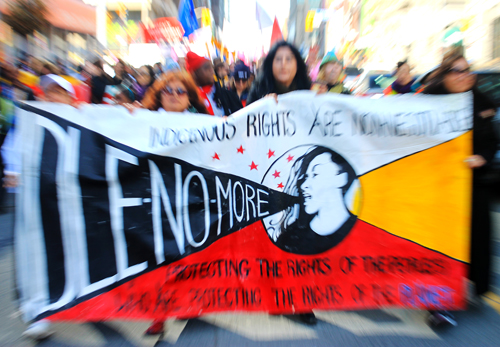
Last year's march focused on fighting the austerity agenda. This year the anti-austerity struggle across the country has been radicalized by Idle No More, began and led by indigenous women, which was a major theme of IWD this year--with indigenous women leading the march under the banner "fires are burning, we are rising."


Recently Human Rights Watch issued a damning report on police abuse of aboriginal women. Challenging violence against women was the second major theme--with people chanting "stop the silence, end the violence." There were also demands for pay equity and childcare.

.
While the Harper government has ignored violence against women, pay equity and childcare, it is claiming to address discrimination against women through Motion 408, scheduled for debate in Parliament later this month, which attacks abortion rights. The fight for reproductive justice was the third major theme of IWD, and the Ontario Coalition for Abortion Clinics mobilized--including their banner "maternal health includes abortion" which led the G20 protests in 2010.


From the G20 protests in 2010, the Egyptian revolution beginning in 2011, and Idle No More that began at the end of 2012--women are at the heart of the fight for a better world. As the motto of IWD says, "the rising of the women is the rising of us all."


Friday, October 29, 2010

HARPER = threat to health

“I’ve been here for five hours,” a patient shouted at the end of my shift, and they were not alone. Working in an ER I see the individuals behind the overcrowding statistics, and the conditions to which patients and healthcare providers are subjected—long waits, being short staffed, assessing and treating patients in the waiting room, admitting people to a hallway. I recently saw someone with a bleed in their brain who left the hospital because they couldn’t stand having to sleep in the hallway.  Last week a man died in an ER waiting room in Montreal, while Alberta ER doctors are also sounding the alarm.

OVERCROWDED, UNDERFUNDED
     Ten years ago the Canadian Association of Emergency Physicians identified ER overcrowding as “a national problem” and “a chronic state in many departments”. They diagnosed this as symptom of the broader healthcare system: “increased waiting times for transfer to an inpatient bed has become the most important cause of Emergency Department overcrowding. Over the past 5 years, hospital beds in Canada have been reduced by almost 40 percent nationally”. According to the Canadian Health Coalition, there were 64,000 hospital bed cuts between 1988 and 2002 and this has not visibly changed for the better since then. This is not because healthcare is unsustainable but because it is underfunded, at both federal and provincial levels.

WHERE’S THE BAILOUT FOR HEALTHCARE?
    
What’s more frustrating is that this unacceptable situation persists despite available resources. Prime Minister Harper did not create this situation, but he (along with provincial governments) in choosing to ignore it. Instead of spending $1 billion on health, he spent it on the biggest mass arrest in Canadian history. Instead of building much needed hospitals, he is spending $9 billion to build prisons despite a falling crime rate, and $18 billion to build fighter jets when most Canadians are opposed to the war. Instead of bailout out healthcare, he is bailing out corporations with $47 billion in corporate tax cuts. 

H.A.R.P.E.R. AGENDA
     ER overcrowding from underfunding is the most visible way in which the government is neglecting our health. But in a broader sense, patterns have emerged over the years of a government agenda that does not just ignore health, but actively undermines it. In the field of health, HARPER has come to stand for:

Humanitarian aid politicization: the Harper government has repeatedly undermined health in Palestine—making Canada the first to cut humanitarian aid to the Palestinian Authority, the first to cut funding to UNRWA that provides healthcare to refugee camps, and the first to criminalize George Galloway for delivering ambulances, food, and medicine. It’s no wonder this bias cost Canada a UN Security Council seat for the first time. In addition, the government militarized aid to Haiti, while practically ignoring the catastrophic floods in Pakistan. The cost of G20 security could have twice covered the $460 million that the UN requested—and has still not received—for health security in Pakistan.

AIDS facilitation: While 25 million people have died of AIDS worldwide and 40 million live with HIV, Harper refused to attend the 2006 International AIDS Conference in Toronto, preferring to tour military bases in the arctic. As UN envoy Stephen Lewis said at the time:
“In a very real way it's a slap in the face to the international community of activists and scientists and researchers and advocates and agencies all gathered to deal with the single greatest problem on the planet… it's just profoundly inappropriate and I think it's a measure of the government's commitment to (fighting) the disease."
     This year, Harper renewed this inappropriate commitment by quietly joining others in underfunding the Global Fund to Fight AIDS, TB and Malaria. As Dr. Jennifer Cohn, MSF HIV/AIDS Policy Advisor said a few weeks ago:
“Today marks a sad turning point in the fight against AIDS, TB, and malaria: world leaders have officially under-financed the Global Fund. This decision will result in the death of millions of people from otherwise treatable diseases.”
     The cost of new fighter jets—built to destroy life—could cover twice over the $8 billion shortfall required to save lives.

Reproductive health prejudice: Conservative MPs introduced two anti-choice bills in 2006 and one in 2008. This year the Harper government is imposing its anti-choice agenda on women in the developing world with a “maternal health plan” that specifically excludes abortion services. According to the Lancet, one the world’s leading medical journals,
“This omission is no accident, but a conscious decision by Canada's Conservative Government not to support groups that undertake abortions in developing countries. This stance must change. 70,000 women die from unsafe abortions worldwide every year… Canada and the other G8 nations could show real leadership with a final maternal health plan that is based on sound scientific evidence and not prejudice.”
Psychological/physical trauma: The Harper government has been complicit in traumatizing detentions of Canadians: delaying repatriation, not apologizing for torture, and maintaining “security certificates”. The government has also been complicit in abuses overseas—transferring Afghan detainees to torture, and deporting US Iraq War resisters to jail for refusing to participate in war crimes.  Harper justifies these policies by claiming to support our troops, but he has silenced those advocating for their healthcare—from Veterans’ Ombudsman Col. Strogan, to veteran advocate Capt. Sean Bruyea—while ignoring military families who oppose the extension of the mission. 

Environmental pollution

While climate change leads to 300,000 deaths a year, Harper abandoned Canada’s Kyoto obligations and has supported tar sands that lead to global pollution and local cancer epidemics for First Nations communities. When Greenpeace dropped banners on Parliament to raise awareness of the health impact of climate change, the government responded by arming Parliamentary guards with machine guns.

Refugee criminalization
    The Harper government is trying to criminalize those fleeing war crimes. It issued Operational Bulletin 202 to criminalize US Iraq War resisters, which the former chair of Canada’s Immigration and Refugee Board Peter Showler described as “fundamentally wrong-headed and a violation of the UN Refugee Convention”. The government claims war resisters interfere with other refugees, but last year Harper was silent over the genocide against tamils, and this year has tried to criminalize the resulting refugees. The Canadian Council for Refugees has responded by stressing that “people who are forced to flee for their lives need to be offered asylum and a warm welcome, not punished".

PRESCRIPTION FOR HEALTH
     Fortunately Canadians are rejecting this bad medicine: campaigning for Medicare and the redirection of military spending, organizing an aid boat to Gaza, exposing Harper’s prejudice concerning abortion and AIDS funding, demanding the repatriation of Omar Khadr and an end to security certificates, mobilizing to support the troops by bringing them home and taking care of their health, demanding sanctuary for war resisters, organizing to stop the tar sands, and opposing the criminalization of refugees. This is truly a prescription for health.
     As I share patient frustration trying to provide individual healthcare in an overcrowded ER, I’m comforted by all the work others are doing outside the hospital to protect and strengthen our collective health.

Friday, October 15, 2010

"Female viagra" and the medicalization of women

The pharmaceutical giant Boehringer Ingelheim has dropped its plan to market its failed antidepressant as a “female viagra” pill. The US Food and Drug Administration slammed the drug studies for failing to produce benefits, while 15% of women dropped out of the study due to side effects like depression, fainting and fatigue. “Female sexual dysfunction” is the latest pharmaceutical attempt to pathologize women, while real healthcare needs go unmet.


"FEMALE VIAGRA"
     According to a recent Globe&Mail article:
“Female sexual dysfunction” – a much-debated term that includes lack of desire and inability to reach orgasm – was entrenched when a 1999 article in the Journal of the American Medical Association announced that 43 per cent of women suffer from some form of sexual dysfunction. Problematically, the lead author was revealed to have financial ties to Pfizer.” 
Marketing this drug as a “female Viagra” is also problematic: Viagra is to achieve a physical erection, while these pills for women are trying to alter their brain chemistry to promote desire they are told is insufficient.  This does not mean taking a nihilistic attitude towards medicine but to acknowledge the impact of profit-driven pharmaceutical companies (for more on this check out the documentary Orgasm Inc.). As Ray Moynihan, co-author of Sex, Lies and Pharmaceuticals: How Drug Companies Plan to Profit from Female Sexual Dysfunction explained in the article above:
“There would be a cohort of women with nerve damage after surgery, or sexual side effects of SSRIs, for which a health professional could be extremely helpful. But to categorize the changes in desire that happen as we move through our lives and relationships as symptoms of a disorder or a dysfunction is highly controversial and questionable. I’m not sure that women going through absolutely normal changes in desire want to identify themselves as suffering from some medical disorder.”
WEAPONS OF MASS PRESCRIPTION
     Like all industries, the pharmaceutical industry is made up of rival firms in competition for market share. In the field of health this produces an inevitable pressure to pathologize. Men now face the prospect of getting treated for “andropause” (age-related decline in testosterone), “obesity” has gone from a risk factor to its own disease requiring pharmaceutical intervention (more on this in a future post), while the notion of “pre-hypertension” is pushing blood pressure medicine on people with normal blood pressure.
     Women have faced a long history of diseases created to pathologize and control their bodies. For centuries women were diagnosed as suffering from “hysteria”—a catch-all term uniquely imposed on women, based on the idea that their uterus (“hyster” in latin) was out of control. As one blogger has summarized:
“The symptoms of hysteria ranged from the erotic to the ludicrous and included fainting, insomnia, fluid retention, vaginal lubrication, ‘voluptuous sensations,’ and, natch, ‘a tendency to cause trouble.’ Sometimes disorders such as epilepsy, anorexia, postpartum depression, and menopause would be misdiagnosed as hysteria, but mostly ‘hysterics’ were just women with a libido and a disapproving patriarch in their lives.” 
“Treatment” varied from incarceration in asylums (more on the history of psychiatry in a later post), surgical removal of the clitoris, or forced orgasm.
     In the 20th century the medical establishment dropped “hysteria”, but  went on to universally medicate older women with Hormone Replacement Therapy (HRT) on the grounds that menopause was a disorder. Pressure from women’s groups helped expose the bad science behind this, culminating in the Women’s Health Initiative showing that indiscriminate use of HRT can lead to breast cancer, heart disease, strokes, and pulmonary emboli.
     Then along came “Pre-Menstrual Dysphoric disorder”. When the patent for the anti-depressant Prozac was about to expire, Eli Lilly got a new patent for it, under a different name, for the treatment of this new “disorder”. According to feminist psychoogist Paul Caplan, "It's a label that can be used by a sexist society that wants to believe that many women go crazy once a month...Any normal hormonal change in people of either sex can exacerbate migraines, thyroid problems, etc., but no one suggests calling men's hormonal changes kinds of mental illness".  Now, with "female seual dysfunction", BigPharma has pathologized women’s sexual lives in order to further push their products.

WOMEN’S HEALTH
     This does not mean dismissing the role of medicine in women’s health, but basing it on women’s needs not pharmaceutical profits. Ironically, the creation of false medical needs runs in parallel with the denial of real needs such as abortion or HIV prevention.

     An alliance between the women’s movement and the progressive medical community struck down laws against abortion, and continues to fight for access--from promoting more teaching about abortion in med schools, to challenging Canada's minority government that wants to deny abortion rights to the 70,000 women around the world who die from unsafe abortion every year. The women's movement was at the forefront of the G20 protests, exposing Harper's war on choice and leading the 40,000 strong march with a giant coat-hanger.
     Women also continue to fight for recognition and prevention of HIV. When AIDS was first discovered it was blamed on gays and Haitians and the impact on women was ignored, resulting in many women being excluded from receiving medicine, services, and disability benefits. Women demonstrated with the slogan “women don’t get AIDS, they only die from it,” demanding the definition include conditions specific to women (like invasive cervical cancer). This succeeded in 1993 and uncovered the true statistics, as the number of women with the diagnosis of AIDS tripled. But HIV continues to be blamed on gay men and promiscuity, for which the main prevention is condoms. In 1991 a group of women working on AIDS prevention in Haiti published a text countering myths about women and AIDS, a list that needs repeating almost 20 years later:
-“AIDS is a disease of men”: the data are overwhelming: AIDS was never a disease of men. Given transmission dynamics, AIDS may in fact becoe a disease predominantly afflicting women
-“Heterosexual AIDS won’t happen": Heterosexual AIDS has already happened. Indeed, in many parts of the world, AIDS is the leading cause of death among young women.
-“women’s promiscuity causes AIDS” : most women with AIDS do not have multiple sexual partners, they have never used IV drugs, they have not received tainted blood transfusions. Their major ‘risk factor’ is being poor. For others, the risk is being married and unable to control not only their husbands but also what jobs their husbands have to perform to make a living.
-“women are AIDS vectors”: ‘women are too often perceived as agents of transmission who infect men and ‘innocent babies’. Prostitutes have been particularly hard hit by such propaganda, but prostitutes are far more vulnerable to infection that to infecting; AIDS is an ‘occupational risk’ of commercial sex work, especially in setting in which sex workers cannot safely demand their clients use condoms.’
- “condoms are panacea”: gender inequality calls into question the utility of condoms in setting in which women’s ability to insist on ‘safe sex’ is undermined by a host of less easily confronted forces. Furthermore, many HIV-positive women choose to conceive children, which means that barrier methods that prevent conception are not the answer for many. Woman-controlled viricidal preventive strategies are necessary, if women’s wishes are to be respected.
To overcome the disconnect between multibillion dollar companies medicating women for manufactured diseases while millions of women are denied basic healthcare needs, healthcare needs to base itself on the needs of people not profit. Our bodies, our choice.