Showing posts with label racism. Show all posts

Tuesday, January 5, 2016

Mandela and anti-colonial struggles


Millions around the world are mourning the loss of the symbol of the anti-apartheid struggle, Nelson Mandela. But people are mourning for different reasons. Most are mourning a freedom fighter who spent 27 years in jail for his opposition to colonialism and racism. Most are mourning a symbol of international solidarity, who spoke out against the Iraq War, supported people with HIV/AIDS and likened the Palestinian freedom struggle to his own. But others are using his death to hide the history of anti-colonial struggles and the contradictions of his later life.

Apartheid: a Canadian tradition
According to The National Post, Conservative Prime Minister Mulroney “spearheaded Canadian push to end apartheid in South Africa and free Nelson Mandela.” Mulroney welcomed Mandela into the House of Commons on June 18, 1990, later claiming that “the very notion of South Africa’s apartheid was anathema to me…I viewed apartheid with the same degree of disgust that I attached to the Nazis…I was resolved from the moment I became prime minister that any government I headed would speak and act in the finest traditions of Canada.”

But South African apartheid was based on Canadian tradition. According to Shannon Thunderbird, a Coast Tsimshian First Nations elder, “It is ironic because the Canadian Indian Act formed much of the basis for the oppressive apartheid policies in South Africa. It’s kind of an understood custom and practice that Canada’s Indian Act came to be known as the acceptable role model for apartheid policies and there are books and websites that outline all of this. It’s actually hypocrisy for Canada to stand forward as a kind of bulwark of protest against atrocities going on in other countries while at the same time we turn a blind eye to our own people.” Mulroney welcomed Mandela while the genocidal residential school system was still operational, and two months before sending thousands of Canadian soldiers to confront the Mohawk blockade at Oka.

It is not only the Conservatives whose tributes to Mandela reveal their hypocrisy. Liberal leader Justin Trudeau and former Prime Minister Jean Chretien called Mandela’s life inspiring, but Mandela certainly did not inspire the White Paper. In 1969—five years into Mandela’s incarceration, when Canada still supported South African apartheid—Prime Minister Pierre Trudeau and his Minister for Indian Affairs Jean Chretien proposed the White Paper to forcibly assimilate First Nations. As the Cree activist Harold Cardinal wrote in his book The Unjust Society (exposing Trudeau’s claims of Canada’s supposed “Just Society”), “In spite of all government attempts to convince Indians to accept the white paper, their efforts will fail, because Indians understand that the path outlined by the Department of Indian Affairs through its mouthpiece, the Honourable Mr. Chrétien, leads directly to cultural genocide. We will not walk this path.”

Anti-colonial struggles
The Red Power movement emerged to challenge Canadian colonialism and defeat the White Paper, and later solidarity with Mandela and the anti-apartheid struggle swept the country. Mandela was part of a mass movement against apartheid that included student and township uprisings, armed resistance, mass strikes, and international solidarity. South African apartheid depended on black workers for profits, so the wave of unionization—including the founding of COSATU in 1985—provided a powerful weapon to organize strikes of millions against apartheid. It was South Africans themselves who spearheaded the push to end apartheid and free Nelson Mandela, not the “humanitarian intervention”  myths about Mulroney.

But there was widespread solidarity against South African apartheid, which has inspired a similar movement against Israeli apartheid. Which is why Western elites are so eager to detach Mandela from the struggle, counter-posing the South African freedom struggle with other anti-colonial struggles. Prime Minister Harper claims that Mandela “demonstrated that the only path forward for the nation was to reject the appeal of bitterness.” But it was the bitterness of fellow Conservative Rob Anders—who in 2001 called Mandela a terrorist—that best expressed how Western elites view anti-colonial struggles. That this label was imposed on the South African freedom fighters should lead us to challenge the criminalization of other anti-colonial struggles—from Palestine to Tamil Eelam to Turtle Island.

South Africa after apartheid
Mandela’s rehabilitation in the eyes of the elites, from terrorist to inspiration, is not because of newfound solidarity with his anti-apartheid past but rather the neoliberal policies of the ANC government. Reacting to news of Mandela’s passing, the World Bank and International Monetary Fund offered their sympathies to the South African people—sympathies that were lacking when these financial institutions imposed structural adjustment policies.

According to South Africa’s Anti-Privatization Forum and Coalition Against Water Privatization, “The majority of South Africans, made up of the poor and working class, fought and died not just for political freedom from apartheid, but for socio-economic freedom and justice, for the redistribution of all ‘national wealth’…This popular mandate was captured in the Reconstruction & Development Programme (RDP), which formed the basis of the ‘people’s contract’ with the new democratic government. However, it did not take long for the ANC government to abandon that popular mandate by unilaterally deciding to pursue a water policy that has produced the exact opposite result… Following the neo-liberal economic advice of the World Bank, the International Monetary Fund and various Western governments (and heavy lobbying by private multinational water companies, such as Suez and Biwater), the South African government drastically decreased grants and subsidies to local municipalities and city councils and supported the development of financial instruments for privatised delivery. This effectively forced local government to turn towards commercialisation and privatisation of basic services as a means of generating the revenue no longer provided by the national state. Many local government structures began to privatise and/or corporatise public water utilities by entering into service and management ‘partnerships’ with multinational water corporations. The immediate result was a massive increase in the price of water that necessarily hit poor communities the hardest.”

But the struggle for socio-economic freedom and justice, against the ANC government and global, corporations—from the Treatment Action Campaign for people with HIV/AIDS, to the protests outside the UN climate talks at Durban, to the strikes at Marikana and beyond. As Mandela himself said in 1993, “You must support the African National Congress only so far as it delivers the goods, if the ANC government does not deliver the goods, you must do to it what you have done to the apartheid regime.” The best tribute to Mandela is to continue the movement he represented—of anti-colonial resistance, student protests, workers strikes, and international solidarity.

Monday, September 7, 2015

Photo essay: Toxic Tour 2015


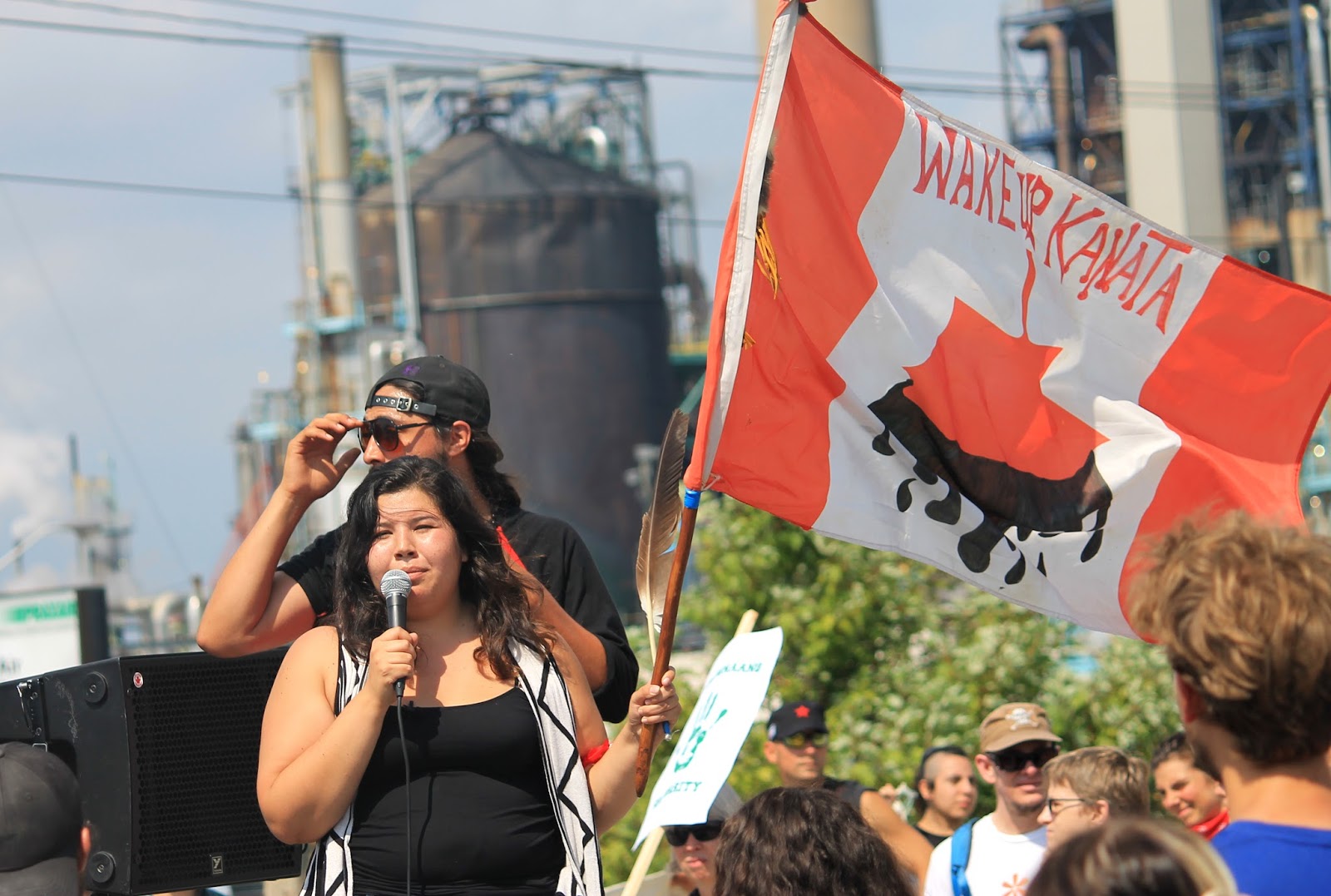
Canada’s Chemical Valley completely surrounds Aamjiwnaang First Nation


Petro-chemical companies poison the earth


They poison the animals


They poison the water


They poison the people


New refineries and new pipelines, like Line 9, threaten to bring even more toxins


And even more spills


But Indigenous youth are rising up


And urging us all to wake up


On September 5, the annual Toxic Tour brought 500 people to Aamjiwnaang, to experience for a few hours what the community lives every day


The police guarded the toxins


While the march guarded the future


The constant drone of lifeless industry was broken by hip hop beats and chants


Indigenous drummers led a round dance


And 500 pairs of hands joined together


To support Indigenous communities


To learn from their experiences


To see the companies driving the climate crisis


To challenge environmental racism


And to build solidarity


for more information visit aamjiwnaangsolidarity.com

Monday, July 27, 2015

Photo essay: Black Lives Matter-Toronto


“No justice, no peace! No racist police!”


“Black is not a crime!”

“Black Lives Matter!”


“Not another life!”

"Indict, convict: send that killer cop to jail. The whole damn system is guilty as hell!"

“We don’t die, we multiply!”

“They can’t stop the revolution. Black power is the solution!”

“Shut it down!”

"I believe that we will win!"

For more information visit Black Lives Matter-Toronto Coalition

Monday, January 26, 2015

Makayla, cancer and colonialism

The tragic death of Makayla Sault—who died of leukemia after stopping chemotherapy—has triggered a backlash. “First Nations parents can now doom their sick children,” warned the Toronto Star. “Dying, because her parents were likely weak and uninformed, possibly misled, and our institutions could not find the backbone to protect this child,” wrote an infuriated doctor in the Ottawa Citizen. “Just how aboriginal rights should matter to any of this in the first place is something that beggars belief,” exclaimed the National Post. What beggers belief is the way in which these remarks ignore and reinforce colonialism.

Cancer, colonialism and capitalism
Makayla died from cancer, an invasive and destructive disease that colonizes the body and extracts its life force without its consent. This is what Canada has done to Indigenous peoples. As Indigenous academic Leanne Betasamosake Simpson explained, “Colonialism and capitalism are based on extracting and assimilating. My land is seen as a resource. My relatives in the plant and animal worlds are seen as resources. My culture and knowledge is a resource. My body is a resource and my children are a resource because they are the potential to grow, maintain, and uphold the extraction-assimilation system. The act of extraction removes all of the relationships that give whatever is being extracted meaning. Extracting is taking. Actually, extracting is stealing—it is taking without consent, without thought, care or even knowledge of the impacts that extraction has on the other living things in that environment. That’s always been a part of colonialism and conquest. Colonialism has always extracted the indigenous—extraction of indigenous knowledge, indigenous women, indigenous peoples.”

As a consequence of living in a system that treats people and the planet as mere resources, regardless of the toxic consequences, we're in the midst of a cancer epidemicwith half of all people in Canada developing some form of cancer. This has been normalized (blamed on our genes or the natural aging process) or blamed on individual "lifestyle choices" like smoking. But much of the cancer epidemic is rooted in the economy that contaminates the earth, water, air and food on which we depend. The pollution of Indigenous territory from the tar sands has led to high cancer rates in Fort Chipewyan, and the carcinogenic economy also affects those on whose labour it depends. 

As the Unifor Prevent Cancer Campaign explains, "Workers in certain carcinogenic-laden industries are contracting cancer at rates well beyond those experienced by the general population. At last 60 different occupations have been identified as posing an increased cancer risk. Studies show that the auto industry is producing laryngeal, stomach and colorectal cancers along with its cars. The steel industry is producing lung cancer along with its metal products. Miners experience respiratory cancers at rates many times higher than the expected levels in the general population. Electrical workers are suffering increased rates of brain cancer and leukaemia. Aluminum smelter workers are contracting bladder cancer. Dry cleaners have a elevated rates of digestif tract cancers. Firefighters contract brain and blood-related cancers at many times the expected levels. Women in the plastics and rubber industry are at greater risk of uterine and possibly breast cancer. The list goes on...Why do we hear so much about the dangers of tobacco but so little about the other 23 lung carcinogens? The reason is that tobacco is claimed to be a 'lifestyle' choice, so industry and the medical profession can blame the victims. The other 23 known causes of lung cancer are related to industry. They can be prevented and removed from our workplaces and our environment."

Colonial medicine
Colonization has included medical arguments and institutions. As the physician and philosopher Frantz Fanon wrote in A Dying Colonialism, “The fact is that the colonization, having been built on military conquest and the police system, sought a justification for its existence and the legitimization of its persistence in its works. Reduced, in the name of truth and reason, to saying ‘yes’ to certain innovations of the occupier, the colonized perceived that he thus became the prisoner of the entire system, and that the French medical service in Algeria could not be separated from French colonialism in Algeria.” The same is true in Canada. As Laurie Meijer Drees writes in Healing Stories: Stories from Canada’s Indian Hospitals, “As early as 1914, sections of the Indian Act allowed the government to apprehend patients by force if they did not seek medical treatment.” This forced treatment denied traditional medicine and included segregated facilities (“Indian hospitals”) that medically experimented on Indigenous people. The same happened in residential schools that stole Indigenous children from their communities—a practice that continues today through other means.

The denial of traditional knowledge included imposing a highly restricted view of healthcare (“Western medicine”) that reduces health to an isolated individual and pharmaceutical intervention—ignoring social, economic, environmental and cultural factors that determine health and the accessibility and effectiveness of pharmaceuticals. There’s nothing inherently Western about this biological reductionism. In his 1845 work Conditions of the Working Class in England, Friedrich Engels outlined a social model of health, and called diseases “the necessary consequence of the present neglect and oppression of the poorer classes.” But a biological reductionist view came to dominate capitalist healthcare—undermining the potential of its own treatments, by ignoring broader factors that shape people’s susceptibility to illness and their potential to access and benefit from medication. Profit-driven pharmaceutical corporations dominate healthcare, creating skepticism and reinforcing a market in equally profit-driven “alternative” medicine like the Florida clinic that treated Makayla.

Right to refuse, and right to access
Given the legacy of colonialism it’s not surprising there might be suspicion towards hospital treatment—especially when accompanied by threats of apprehension, in order to enforce such a difficult regimen as chemotherapy (despite its effectiveness in treating leukemia). We might disagree with the choice to stop chemotherapy, though Makayla did brave it for nearly three months before stopping it (contrary to media headlines that she simply refused it). But as the courts found, “(Makayla’s mother’s) decision to pursue traditional medicine for her daughter is her aboriginal right. Further, such a right cannot be qualified as a right only if it is proven to work by employing the western medical paradigm. To do so would be to leave open the opportunity to perpetually erode aboriginal rights.”

Despite media claims, “Indigenous rights vs Western medicine” is a false dichotomy. While Makayla died after stopping treatment, there are far more Indigenous people who die from being denied access to treatment and prevention—and this sparks far less fury from the mainstream media. “Racism can doom sick patients,” could have been the headline after Brian Sinclair died in a Winnipeg ER, denied treatment for 34 hours. “Our institutions could not find the backbone to protect this community,” could be written about the Ontario government’s refusal to support the community of Grassy Narrows against mercury poisoning. “Cancer rates in Fort Chipewyan beggar belief,” should be included in every discussion of the tar sands.

If we’re concerned about private clinics profiting from dubious claims and treatments, then the response should not be to blame Indigenous families who chose that option. Instead we need to strengthen public healthcare, including creating a national pharmacare program and stopping Harper’s $36 billion cut to health care (and the federal government's denial of chemotherapy to refugees).

Decolonizing medicine
Thanks to Indigenous sovereignty and solidarity movements there are growing attempts to decolonize medicine. As Brantford physician Chris Keefer wrote last spring in the Two Row Times, “By behaving in a manner consistent with a colonial master’s mentality, McMaster Children’s Hospital and members of the medical team have very unfortunately created a lack of trust and a break in the therapeutic bond between the medical team and the family. Threats of apprehension of Onkwehon:we children, the dis-respect of elders in family meetings, and denigrating remarks about traditional medicines have no place in a respectful two row relationship. Such actions, comments and behaviours extinguish the opportunity to build trust with the family, trust that is necessary to encourage the family to pursue a very difficult two year treatment plan marked by severe and even life threatening side effects. As a medical doctor trained within Canadian society with no experience of traditional Onkwehon:we medicines, I am not sure that the family is making the right choice by refusing chemotherapy. However it is not my right as a member of Canadian society to impose my will upon Onkwehon:we people.”

The Canadian Medical Association Journal has taken the same progressive approach. In their article “Caring for Aboriginal patients requires trust and respect, not courtrooms,” Lisa Richardson of the UofT Office of Indigenous Medical Education and magazine deputy editor Matthew Stanbrook write: “Media coverage has fueled a narrative of polarized paradigms that is unhelpful and misleading, implying false choices. Medical science poses no inherent conflict with Aboriginal ways of thinking. Medical science is not specific to a single culture, but is shared by Aboriginal and non-Aboriginal people alike. Most Aboriginal people seek care from health professionals—but nearly half also use traditional medicines. Aboriginal healing traditions are deeply valued ancestral practices that emphasize plant-based medicines, culture and ceremony, multiple dimensions of health (physical, mental, emotional and spiritual), and relationships between healer, patient, community and environment. These beliefs create expectations that Aboriginal patients bring to their health encounters; these must be respected. Doing so is not political correctness—it is patient-centered care…For the state to remove a child from her parents and enforce medical treatment would pose serious, possibly lifelong, repercussions for any family, but such action holds a unique horror for Aboriginal people given the legacy of residential schools. To make medical treatment acceptable to our Aboriginal patients, the health care system must earn their trust by delivering respect.”

At the same time we can learn from Indigenous teachings to broaden our conception of health and healthcare. As the National Aboriginal Health Organization explains, health indicators include not only individual lifestyle behaviours like smoking and physical activity, but also health knowledge, personal resources, health services (both access to physicians and Aboriginal representation in health professions), physical environment, and social and economic environment. Rather than blaming a family for their tragedy, we should be collectively working to improve these determinants of health, so that we can treat and prevent cancer and replace the cancerous system driving it with one that respects people and the planet. As the Six Nations of the Grand River and the Mississaugas of the New Credit explained “We sincerely hope that this decision is part of an emerging era of healing and reconciliation between Canada and our nations. We hope that our children and generations to come will no longer experience the mistrust, misunderstanding, and mistreatment by the Canadian government that have been our daily reality for over 200 years.”

Tuesday, November 25, 2014

From Mike Brown to Jermaine Carby: Toronto rallies for justice


Less than 24 hours after a St. Louis grand jury failed to indict police officer Darren Wilson for killing Mike Brown, Toronto rallied with cities across the country to say that Black lives matter.


Wilson shot the unarmed Black teenager six times and got away with murder. Meanwhile dozens of Black people have been arrested for protesting the lack of justice.


Three thousand people assembled across from the US consulate against police brutality, from Ferguson to Toronto.


Last year Toronto was rallying against the killing of Sammy Yatim, this year it is Mike Brown and Jermaine Carby, amongst others. As people chanted, "the system's not broken, it was built this way."


As La Tanya Grant, a cousin of Jermaine Carby explained, he was also unarmed, also shot to death, and also criminalized after the fact as justification. "Justice for Jermaine," the crowd chanted.


The campaign for justice continues. For more information visit Justice for Jermaine Carby.


Friday, December 6, 2013

Mandela and anti-colonial struggles


Millions around the world are mourning the loss of the symbol of the anti-apartheid struggle, Nelson Mandela. But people are mourning for different reasons. Most are mourning a freedom fighter who spent 27 years in jail for his opposition to colonialism and racism. Most are mourning a symbol of international solidarity, who spoke out against the Iraq War, supported people with HIV/AIDS and likened the Palestinian freedom struggle to his own. But others are using his death to hide the history of anti-colonial struggles.

Apartheid: a Canadian tradition
According to The National Post, Conservative Prime Minister Mulroney “spearheaded Canadian push to end apartheid in South Africa and free Nelson Mandela.” Mulroney welcomed Mandela into the House of Commons on June 18, 1990, later claiming that “the very notion of South Africa’s apartheid was anathema to me…I viewed apartheid with the same degree of disgust that I attached to the Nazis…I was resolved from the moment I became prime minister that any government I headed would speak and act in the finest traditions of Canada.”

But South African apartheid was based on Canadian tradition. According to Shannon Thunderbird, a Coast Tsimshian First Nations elder, “It is ironic because the Canadian Indian Act formed much of the basis for the oppressive apartheid policies in South Africa. It’s kind of an understood custom and practice that Canada’s Indian Act came to be known as the acceptable role model for apartheid policies and there are books and websites that outline all of this. It’s actually hypocrisy for Canada to stand forward as a kind of bulwark of protest against atrocities going on in other countries while at the same time we turn a blind eye to our own people.” Mulroney welcomed Mandela while the genocidal residential school system was still operational, and two months before sending thousands of Canadian soldiers to confront the Mohawk blockade at Oka.

It is not only the Conservatives whose tributes to Mandela reveal their hypocrisy. Liberal leader Justin Trudeau and former Prime Minister Jean Chretien called Mandela’s life inspiring, but Mandela certainly did not inspire the White Paper. In 1969—five years into Mandela’s incarceration, when Canada still supported South African apartheid—Prime Minister Pierre Trudeau and his Minister for Indian Affairs Jean Chretien proposed the White Paper to forcibly assimilate First Nations. As the Cree activist Harold Cardinal wrote in his book The Unjust Society (exposing Trudeau’s claims of Canada’s supposed “Just Society”), “In spite of all government attempts to convince Indians to accept the white paper, their efforts will fail, because Indians understand that the path outlined by the Department of Indian Affairs through its mouthpiece, the Honourable Mr. Chrétien, leads directly to cultural genocide. We will not walk this path.”

Anti-colonial struggles
The Red Power movement emerged to challenge Canadian colonialism and defeat the White Paper, and later solidarity with Mandela and the anti-apartheid struggle swept the country. Mandela was part of a mass movement against apartheid that included student and township uprisings, armed resistance, mass strikes, and international solidarity. South African apartheid depended on black workers for profits, so the wave of unionization—including the founding of COSATU in 1985—provided a powerful weapon to organize strikes of millions against apartheid. It was South Africans themselves who spearheaded the push to end apartheid and free Nelson Mandela, not the “humanitarian intervention” myths about Mulroney.

But there was widespread solidarity against South African apartheid, which has inspired a similar movement against Israeli apartheid. Western elites are eager to detach Mandela from the struggle, counter-posing the South African freedom struggle with other anti-colonial struggles. Prime Minister Harper claims that Mandela “demonstrated that the only path forward for the nation was to reject the appeal of bitterness.” But it was the bitterness of fellow Conservative Rob Anders—who in 2001 called Mandela a terrorist—that best expressed how Western elites view anti-colonial struggles. That this label was imposed on South African freedom fighters should lead us to challenge the criminalization of other anti-colonial struggles—from Palestine to Tamil Eelam to Turtle Island.

South Africa after apartheid
Mandela’s rehabilitation in the eyes of the elites, from terrorist to inspiration, is not because of newfound solidarity with his anti-apartheid past but rather the neoliberal policies of the ANC government. Reacting to news of Mandela’s passing, the World Bank and International Monetary Fund offered their sympathies to the South African people—sympathies that were lacking when these financial institutions imposed structural adjustment policies in the 1990s.

According to South Africa’s Anti-Privatization Forum and Coalition Against Water Privatization, “The majority of South Africans, made up of the poor and working class, fought and died not just for political freedom from apartheid, but for socio-economic freedom and justice, for the redistribution of all ‘national wealth’…This popular mandate was captured in the Reconstruction & Development Programme (RDP), which formed the basis of the ‘people’s contract’ with the new democratic government. However, it did not take long for the ANC government to abandon that popular mandate by unilaterally deciding to pursue a water policy that has produced the exact opposite result… Following the neo-liberal economic advice of the World Bank, the International Monetary Fund and various Western governments (and heavy lobbying by private multinational water companies, such as Suez and Biwater), the South African government drastically decreased grants and subsidies to local municipalities and city councils and supported the development of financial instruments for privatised delivery. This effectively forced local government to turn towards commercialisation and privatisation of basic services as a means of generating the revenue no longer provided by the national state. Many local government structures began to privatise and/or corporatise public water utilities by entering into service and management ‘partnerships’ with multinational water corporations. The immediate result was a massive increase in the price of water that necessarily hit poor communities the hardest.”

But the struggle for socio-economic freedom and justice, against the ANC government and global corporations, continues—from the Treatment Action Campaign for people with HIV/AIDS, to the protests outside the UN climate talks at Durban, to the strikes at Marikana and beyond. As Mandela himself said in 1993, “You must support the African National Congress only so far as it delivers the goods, if the ANC government does not deliver the goods, you must do to it what you have done to the apartheid regime.” The best tribute to Mandela is to continue the movement he represented—of anti-colonial resistance, protests and strikes, and international solidarity.

Thursday, October 3, 2013

9 reasons to stop Line 9


Without even an environmental assessment, oil giant Enbridge wants to use a 38-year old pipeline to pump toxic tar sands through the most populated corridor in the country, promoting the tar sands and contributing to climate change. As Toronto enters a two week calendar of events for environmental justice, culminating in a rally on October 19, here are 9 reasons to stop Line 9.

1) challenge the tar sands
Line 9 will encourage the development of the tar sands, which are devastating indigenous communities. According to the Indigenous Environmental Network, “Northern Alberta is ground zero with over 20 corporations operating in the tar sands sacrifice zone, with expanded developments being planned. The cultural heritage, land, ecosystems and human health of First Nation communities including the Mikisew Cree First Nation, Athabasca Chipewyan First Nation, Fort McMurray First Nation, Fort McKay Cree Nation, Beaver Lake Cree First Nation, Chipewyan Prairie First Nation, and the Metis, are being sacrificed for oil money in what has been termed a “slow industrial genocide”. Infrastructure projects linked to the tar sands expansion such as the Enbridge Northern Gateway pipeline and the Keystone XL pipeline, threaten First Nation communities in British Columbia, Canada and American Indian communities throughout the United States.” Stopping Line 9 would support communities resisting the tar sands, and prevent its spread eastwards.

2) reduce climate change
As former NASA climatologist James Hansen has warned, “If humanity wishes to preserve a planet similar that on which civilization developed and to which life on Earth is adapted, paleoclimate evidence and ongoing climate change suggest that CO2 will need to be reduced ... to at most 350 ppm.” This year, for the first time in human history, atmospheric concentrations of CO2 reached 400ppm. In this context we’re seeing increasing climate disasters—from hurricane Sandy to epic floods in Alberta and Toronto.

According to a Canadian scientist and coordinating author of the recently released IPCC report, “evidence for a warming climate is getting stronger and stronger, and the evidence of the influence of human activities on that climate change is getting stronger and stronger…Climate change and warming in particular is amplified—that is, it’s larger—at higher latitudes. So warming over Canada is larger than the warming that has been experienced [worldwide] and it is projected to continue that way. That warming over Canada will continue to be more rapid than the global [average] warming.” 

The tar sands are Canada’s fastest growing source of carbon emissions, and both its local and global affects disproportionately affect communities impacted by poverty and racism. Stopping Line 9 and other tar sands pipelines is critical to reduce climate change.

3) prevent oil spills
Pipeline spills happen all the time--including Enbridge’s Line 6B that spilled 3 million litres into the Kalamazoo River in 2010, the spill of millions of litres in Lubicon territory in 2011, the spill last March in a residential neighbourhood in Arkansas, and the spill this June in Alberta from Enbridge’s Line 37. As an Arkansas resident said: “I didn’t even know the oil pipeline was there…she called me and said, ‘Honey, something’s wrong.’ I came out and smelled it. Then I saw it coming down the street.”

This is what’s in store for communities along the Line 9 route. According to the city of Toronto’s submission to the National Energy Board, “Neither the TTC, Toronto Fire Services nor Enbridge appear to have any specific contingency plan to manage a leak of petroleum should this occur near the TTC entrances…The top stair of the Bishop Avenue stairwell is at grade and provides no barrier to the flow of the product should there be a release. If any petroleum product was discharged either down the stairs or the escalators, or by other routes into the TTC concourse, platform or track level, there would be an enormous risk to thousands of daily passengers and TTC workers.”

These bitumen spills can’t just be “cleaned up”: some components evaporate and poison the air, while others sink and poison the earth and water. Three years and a billion dollars in clean-up fees later, and the Kalamazoo River is still contaminated. We need to stop Line 9 before it spills.

4) protect water
Massive amounts of water are wasted in tar sands production, which then contaminates the local water while pipelines threatens distant water. In the words of Toronto city counselor Anthony Perruzza: “The City of Toronto sits at one of the biggest freshwater supplies in the world. These pipelines cross the city, traverse it completely. Any leakage, any rupture, any break, any undetected leaks over time will have disastrous consequences for us and for our water.” With the pipeline running down Finch avenue--and not Bay Street or wealthy neighbourhoods in Toronto--oil spills would add to the poverty and racism already imposed on these communities. The best way to prevent these disastrous consequences is to stop the pipeline.

5) promote health
Tar sands and the oil industry is harmful to our health. Fort Chipewyan, downstream of the tar sands, is experiencing higher cancer rates. The working conditions in Fort McMurray contribute to an array of social costs, including the exploitation of migrant workers, and increased rates of suicide, addiction and abuse; a few years ago the director of Fort McMurray’s only woman’s shelter went on hunger strike to demand more resources. Pollution from oil and other petrochemical companies in Chemical Valley undermine health in Aamjiwnaang First Nation and Sarnia. According to the World Health Organization, “Climatic changes already are estimated to cause over 150,000 deaths annually… The risks are concentrated in the poorest populations, who have contributed the least to the problem of greenhouse gas emissions.” Stopping Line 9 would be a small but concrete step towards reversing the health impacts of the oil economy.

6) rebuild democracy
There has been no free, prior and informed consent from First Nations for Line 9, or the tar sands. Harper has undermined environmental regulation, there has been no environmental assessment for Line 9, and Enbridge has given “donations” to municipalities along the route (including the Hamilton police, who arrested line 9 protesters for occupying a pumping station). The National Energy Board (an “ally” of the Harper government) has monopolized decision-making power, excluded people from contributing to hearings, and tried to divide the movement between those they allow to intervene and those they do not allow. Challenging Line 9 exposes these attacks on democracy, as part of a movement to rebuild democracy.

7) support indigenous sovereignty
As IEN states, “Just a few years ago, people in Canada, U.S. and Europe heard little to nothing about the Canadian tar sands. Today, the tar sands have become a topic of national and international discussion as stories of cancer epidemics in the community of Fort Chipewyan, massive wildlife losses related to toxic contamination, environmental degradation and increased vocal resistance from impacted communities have shattered the ‘everything is fine’ myth propagated by the Canadian and Alberta governments.”

From declaration of unity against pipelines to Healing Walks, from freedom train to speaking tour, indigenous communities are leading the movement against tar sands, and providing an environmental justice framework to understand the threat of tar sands and the importance of indigenous sovereignty and solidarity.

8) demand green jobs
The billion dollars in subsidies to the tar sands each year could provide thousands of green jobs, and the climate justice movement includes labour activists pushing for a just transition from the oil economy to one based on sustainability. Last year unions endorsed a sit-in against tar sands pipelines and tankers, and this year the Steelworkers Toronto Area Council has endorsed the rally against Line 9 and provided funding for First Nations activists to bus into Toronto to join the rally. As a CAW organizer said last year, “tens of thousands of unionized and other jobs depend on healthy river and ocean ecosystems. We will be standing in solidarity with thousands of working people in BC and our First Nations sisters and brothers.” Line 9 will only produce a few temporary jobs in an industry that exposes workers to chemicals while undermining the environment on which future jobs depend. Stopping Line 9 is part of a movement demanding good green jobs for all.

9) build the environmental justice movement
Last October 22 there was a mass sit-in in Victoria, led by Coastal First Nations with participation from environmental groups and unions. On February 17 there was a huge protest outside White House against the Keystone XL pipeline. These movements are creating major barriers to pipelines going west and south, and there is a similar movement emerging against Line 9, from Aamjiwnaang to Montreal. During the next two weeks in Toronto there is a series of events leading up to the National Energy Board hearings, where people will be intervening against Line 9 in the hearings and in the streets. Join the movement!

*Sunday October 6: Rock the Line with Environmental Defense, free concert, 2pm Mel Lastman Square

*Monday October 7: #Oct7 National day of Unity in Action, Idle No More Toronto, 5pm at Trinity Bellwoods

*Tuesday October 15: Do The Math movie screening and panel discussion, by Toronto350, 5:45pm and 8:15pm at Bloor Hot Docs Cinema

*Friday October 18: Tar Sands Reality Check Tour6pm at Bloor Street United Church

*Saturday October 19: NO LINE 9! NO TAR SANDS PIPE LINES, rally at noon outside the NEB hearings (Metro Convention Centre, 255 Front Street). “Indigenous communities, environmentalists and labour groups have united to oppose the tar sands pipelines going west and south, and we need a similarly impressive display of mass opposition to any such proposal to transport tar sands east. Stopping the Line 9 Pipeline Reversal and moving toward a clean energy economy with green jobs would be a multiple “win” – a win for communities, jobs, farms, the environment, public health, and for our long-term energy security. Join us October 19th outside the NEB hearings as we say No Line 9! No Tar Sands Pipelines!”